
The Quick Read: Yes, a portfolio DSCR loan can refinance several rentals that include a duplex, because a duplex is a standard 2-4 unit residential property and fits in the same pool as single-family homes, condos, and townhomes. Qualification runs on pooled rent against pooled debt service, subject to lender guidelines, credit approval, and a review of each property.
- A duplex is eligible in the pool. An owner-occupied duplex is not.
- The 30-year portfolio DSCR loan covers 2 to 20 properties under one note, with leverage up to 80% on a rate-and-term refinance.
- Cash-out on a pool never exceeds 75% of pooled value.
- Pooled coverage of 1.00 is the floor, so stronger rentals can offset weaker ones.
- Every property still needs a lease or an appraiser-supported market rent. Final terms depend on the lender’s guidelines, the property type, and the borrower’s complete credit picture.
Think of this as a lookup page. The answer is yes, and the useful part is knowing where the yes gets conditional.
What Does “Refinancing Rentals Into One Loan” Actually Mean?
It means one new note, secured by liens on several rental properties, pays off the existing loans on each. A portfolio DSCR loan, a blanket loan, and a cross-collateralized loan all name the same thing. A legal glossary from Barnes Walker defines a blanket mortgage as one mortgage covering two or more parcels, usually with a partial release feature.
One wrinkle on vocabulary. When a bank says “portfolio loan,” it often means a loan the bank keeps on its own books. That is a different sense of the word and not necessarily a blanket loan. This article uses the term only in the blanket sense.
The alternative is separate DSCR loans, one per rental, each qualified on its own rent against its own payment. That needs no special product. Lendmire, a DSCR-focused mortgage broker, arranges both routes through its wholesale network, so the real question is which structure fits the investor’s plan.
Where Does a Duplex Fit in the Pool?
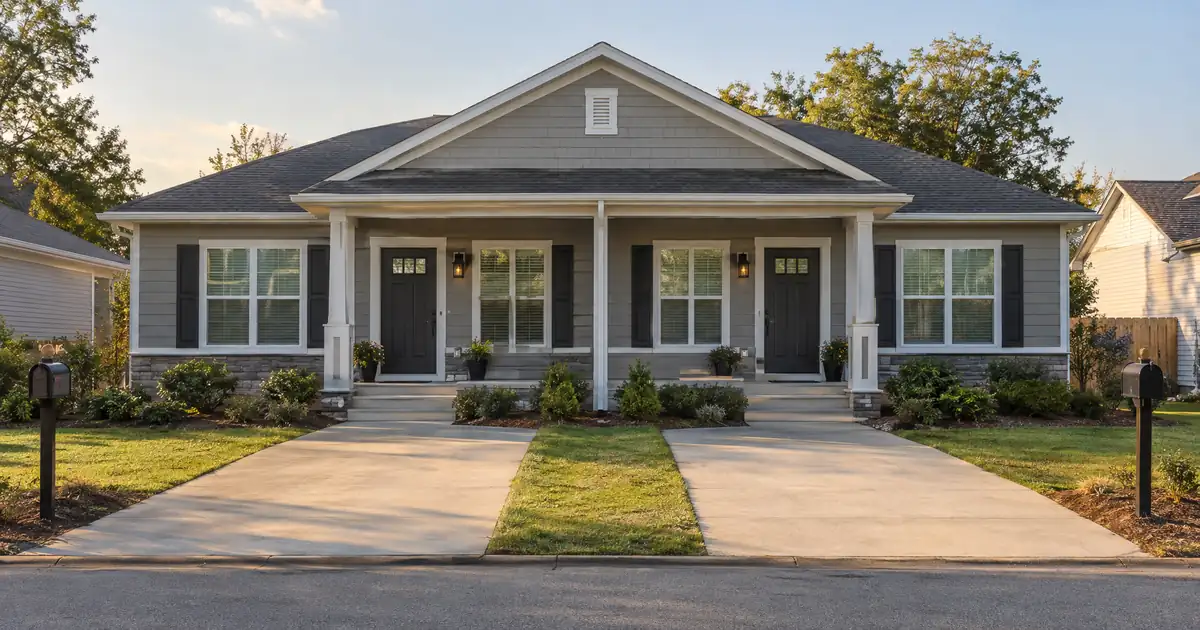
A duplex fits as an ordinary pool member. Both the 30-year portfolio DSCR loan and the rental portfolio term loan accept single-family, 2-4 unit, condo, and townhome properties. The term loan also accepts small multifamily of five or more units, which the 30-year structure does not.
The line that matters is four units versus five. Two to four units is a residential property. Five or more is generally treated as commercial or multifamily, so it only belongs in the rental portfolio term loan.
The duplex is valued differently from a house. Fannie Mae’s Selling Guide shows the contrast: Form 1004 covers one-unit properties and Form 1025 covers two- to four-unit properties. That is a form-name contrast only, since DSCR loans are not agency products. An appraiser’s guide to Form 1025 explains that it captures income at the unit level, with a condo or PUD addendum when the duplex sits in a project.
In practice, the duplex’s rent is counted across both units, supported by two leases or by an appraiser’s market-rent opinion. If one side is vacant, there is no lease to lean on, so the appraiser’s opinion carries that unit. Duplexes often help a pool because two tenants spread vacancy risk across one roof. A single-family rental is all-or-nothing.
What does not fit: an owner-occupied duplex. Portfolio DSCR pools are non-owner-occupied investment property only. Mixed-use buildings and commercial property are out too. Manufactured and mobile homes are not reviewable on these programs.
How Does the Pooled Coverage Math Work?
Coverage on the pool is total monthly rent divided by total monthly PITIA, meaning principal, interest, taxes, insurance, and any HOA dues. The 30-year portfolio DSCR loan uses a 1.00 floor measured on the whole pool, so a strong rental can carry a thin one.
Run the numbers on a modeled pool of three properties: a single-family house covering its payment at roughly 1.25x, a condo near 1.05x, and a duplex around 0.95x. The duplex misses 1.00 alone. Pooled, the three together land near 1.08x, which clears the floor. These ratios are illustrative assumptions, not market data.
Two cautions come with that. First, a property below 1.00 can sit in the pool only because underwriting tests the pooled coverage, the leverage, and the terms together. Second, clearing 1.00 is not the same as positive cash flow. DSCR compares rent to PITIA only. Repairs, vacancy, management, utilities, and capex sit outside the calculation, and a duplex with older systems can eat a thin margin fast.
Per-property review still happens. A stale or below-market lease can drag the pool down, and “blended” does not mean an individual rent stops mattering.
Pooled Note or Separate Loans?
The two structures trade simplicity against flexibility. The table compares them.
| Factor | Pooled note | Separate loans |
|---|---|---|
| Closings and servicers | One of each | One per property |
| Weak property | Can ride on stronger ones | Must qualify alone |
| Selling one door | Follows release terms | Sell freely |
| Cross-collateralization | Yes, all properties back one debt | No |
| Adding a property later | Usually a modification or new loan | Its own loan |
Pooling tends to pay off for investors with several similar, stable rentals who plan to hold. It tends to disappoint the investor who flips or sells a door every year. The release price on a blanket runs above that property’s allocated balance, and the remaining pool must still cover its debt service afterward.
A hybrid often works best. Pool the uniform, stable properties and finance the odd ones separately. Lendmire’s piece How to Split a Duplex in an LLC Portfolio and Refinance on DSCR covers one version of that decision.
Which Portfolio Structure Fits Which Investor?
Across the wholesale network, two portfolio structures cover most requests.
The 30-year portfolio DSCR loan suits smaller pools. It takes 2 to 20 properties under one note, with loan sizes from $300,000 to $5,000,000 (larger balances on review). Leverage goes up to 80% of value on a purchase or rate-and-term refinance. The term is 30 years, fixed or adjustable, and an interest-only period is available. Each figure is subject to lender guidelines and a complete review of property type, leverage, and credit.
The rental portfolio term loan suits larger pools. It requires five or more rental properties or units, with loan sizes from $500,000 to $50,000,000 (larger balances on review) and leverage up to 75% of value. Terms run 3, 5, 7, or 10 years at fixed pricing with a balloon at maturity, and prepayment follows yield maintenance. Non-recourse structures exist, with carve-outs such as fraud and bankruptcy; recourse versions carry a personal guarantee. Properties in several markets can sit under one loan. Leverage, reserves, and pricing vary by lender and program; the final terms follow the full file review.
Small pools of two or three rentals often gain little from pooling, since one closing replaces only two or three. Minimum pool size and loan size can also rule out the smallest portfolios, so total cost is worth comparing before committing.
What Do Lenders Review?
Lenders review the pool as a whole and each property inside it. Expect the file to cover these items:
- Pooled coverage: total rent against total PITIA, at or above 1.00 on the 30-year structure.
- Per-property value and leverage: each property is valued, and the note assigns an allocated loan amount to each.
- Credit: the portfolio programs carry a 640 floor, with 680 or 720 on some structures.
- Entity setup: some structures require a special-purpose entity, typically an LLC, subject to lender program eligibility.
- Rent support: a lease or an appraiser-supported market rent for every property.
- Reserves: held for taxes, insurance, and capital expenditures on the term loan; amounts vary by structure.
Cash-out has its own limits. A cash-out on a pool never exceeds 75% of pooled value. Inside the first six months of ownership, the loan is also capped at 90% of total cost (purchase price plus documented improvements), and at 100% of total cost from six to twelve months, and the loan is the lower of the two. After twelve months the appraised value alone is the basis. A rate-and-term refinance is not subject to the cost-basis cap. The full set of program mechanics sits in Lendmire’s complete DSCR loans guide.
Across the files this type of structure typically produces, the duplex is rarely the problem. The usual friction is a rent figure that depends on a lease the tenant has not signed or a vacant unit with no support. Getting leases and rent roll organized before the file goes to a lender prevents most of the back-and-forth.
The Refinance Sequence, Step by Step
1. Choose the structure. Decide between one pooled note and separate loans.
2. Assemble the pool. List each property with its lease or market rent, taxes, insurance, and HOA dues.
3. Test pooled coverage. Add the rents, add the PITIA, and compare.
4. Order valuations per property. One loan does not mean one appraisal. The duplex gets a 1025-type report with a unit-level rent analysis, and a single-family rental gets a 1004 with a rent schedule.
5. Set allocations. The note assigns a loan amount to each property, and those amounts drive release pricing later.
6. Pay off and record. Old liens are paid off and released, one new lien is recorded against each property, and the investor makes one payment.
Before step 1, check the loans being replaced for prepayment terms. Payoff costs can erase the savings of consolidating, so a loan with a heavy penalty may be better left alone until it steps down.
What If the Pool Doesn’t Clear 1.00?
Find the weakest property first, then choose among four moves.
1. Drop it from the pool and refinance it separately, or leave its current loan in place.
2. Shrink the pool to the properties that clear together.
3. Lower the leverage on a cash-out request, which reduces the debt service the rent must cover.
4. Wait for rents to reset if leases are below market and renewals are near.
A larger down payment or paydown lowers the monthly payment and can lift coverage, but it never erases leverage caps, credit floors, or property eligibility. The strongest files clear both tests: enough equity and enough rental coverage.
For a single-property loan outside the pool, coverage below 1.00 is available through select lenders in the network, with leverage and terms adjusted. That is a different path from a pool, whose coverage floor stays at 1.00. No-ratio qualification exists on single-property loans through select wholesale programs, generally for borrowers who already own a primary residence, and it is not the portfolio structure.
Who Should Skip the Pool?
Skip pooling if any of these describe the plan:
- A sale is coming. Selling one property means a release payment above its allocated balance, plus a retest of what remains.
- The pool is only two small rentals. The closing savings rarely justify cross-collateralization.
- The properties are very different. Mixed assets, several owning entities, or staggered exit dates complicate a single note.
- Growth is the plan. A pool is usually locked at underwriting, so a new rental needs a modification, a refinance of the whole pool, or its own loan.
The flip point runs the other way for an investor with several similar rentals, a long hold, and a wish to stop juggling servicers. Cross-collateralization is the price. Trouble on one asset can touch the whole pool, and that risk deserves a straight look.
Key Terms Defined
Blanket loan: one note secured by liens on two or more properties, also called a portfolio DSCR loan or cross-collateralized loan.
PITIA: the monthly principal, interest, taxes, insurance, and association dues that rent is measured against.
Pooled coverage: total rent across the properties divided by their total PITIA.
Release clause: a loan term that lets one property leave the pool for a payment above its allocated balance.
Cross-collateralization: every property in the pool backs the same debt.
Allocated loan amount: the share of the note assigned to each property.
Frequently Asked Questions
Can an owner-occupied duplex go in a portfolio DSCR pool?
No. These pools hold non-owner-occupied investment property only. If the investor lives in one unit, that duplex stays outside the pool and is financed through an owner-occupied program instead. A duplex the investor has moved out of and fully rents can qualify like any other rental.
How is the duplex’s rent counted?
Both units count together, supported by leases or by an appraiser’s market-rent opinion. A vacant unit has no lease, so the appraiser’s figure carries it. The rent is gross rent measured against the full PITIA, not net operating income.
Can a duplex be refinanced alone on a DSCR loan?
Yes. A single-property DSCR loan accepts a duplex, with typical purchase leverage of 75%-80% and a cash-out ceiling of 75%, subject to lender guidelines. Pooling is optional and mainly makes sense when several rentals can be handled together.
Can the investor add a property to the pool later?
Usually not directly. A pool is generally locked at underwriting, so a new rental needs a modification, a refinance of the whole pool, or its own loan.
Does clearing 1.00 mean the pool cash-flows?
No. DSCR compares rent to PITIA only. Vacancy, repairs, management, utilities, and capex sit outside the number, so a pool at 1.05x can still run tight in a bad year.
If you are buying or refinancing a rental property and want to see how the numbers work, Lendmire can help you compare DSCR loan options based on the property income, credit profile, leverage, and investor goals. Reach the team at 828-256-2183 or request a quote. Qualification is subject to lender guidelines and is not a commitment to lend.
The practical test for any pool is the weakest door: if the investor would be comfortable owning that duplex on its own terms, the blanket note only adds convenience, and if not, the pool is hiding a problem rather than solving one.
About Lendmire
Lendmire (NMLS# 2371349) is a DSCR-focused mortgage broker that helps arrange investor financing across 41 markets, including Washington, D.C., through wholesale and investor-lending channels. DSCR eligibility is generally reviewed by the lender around the property’s rental income rather than personal income documentation, subject to lender guidelines — which works for self-employed investors, LLC operators, and portfolios above four financed properties. Scotsman Guide named Lendmire a Top Mortgage Workplace in both 2025 and 2026.
Get Started
Ready to find the right loan for you?
In about 30 seconds you can review financing options available for your investment property. No commitment required.
Informational only. Not a Loan Estimate, approval, or commitment to lend. Program availability and eligibility are subject to lender guidelines, credit approval, property review, and underwriting.
References
1. Barnes Walker legal glossary: blanket mortgage
2. Form 1004 covers one-unit properties and Form 1025 covers two- to four-unit properties
3. New Jersey Real Estate Appraisal blog: Form 1025
This article is part of Lendmire’s DSCR loan program — full qualification details, guidelines, and scenarios live on the program page.
Related reading: Hard Money vs DSCR Loan if a Land Contract Seller Will Not Refinance · Does ADU Rent Count on a Portfolio DSCR Loan on Several Rentals? · Portfolio DSCR Loan Requirements When One Tenant Is Behind on Rent
Brandon Miller
Founder & CEO, Mortgage Loan Originator, Lendmire LLC
- Mortgage Loan Originator · NMLS# 1129696 · Verify on NMLS Consumer Access
- North Carolina Real Estate Broker · License# 343312 · Verify on NCREC
- North Carolina Insurance Producer · License# 19053198 · Property, Casualty, Life, Health · Verify on NAIC SBS
- Lendmire LLC · Firm NMLS# 2371349 · Verify firm licensure
Disclosure information. Lendmire is a state-licensed mortgage brokerage under NMLS# 2371349. Lendmire is not a depository institution, direct lender, or financial advisor — all loans referenced are placed through wholesale lender partners and are subject to each lender's underwriting standards. This article is provided for general informational purposes and is not a commitment to lend, nor does it constitute financial, legal, or tax advice. Loan programs, terms, rates, and qualification standards change without notice and depend on borrower profile, property type, and the state in which the subject property is located. Equal Housing Opportunity provider. NMLS Consumer Access: nmlsconsumeraccess.org.