
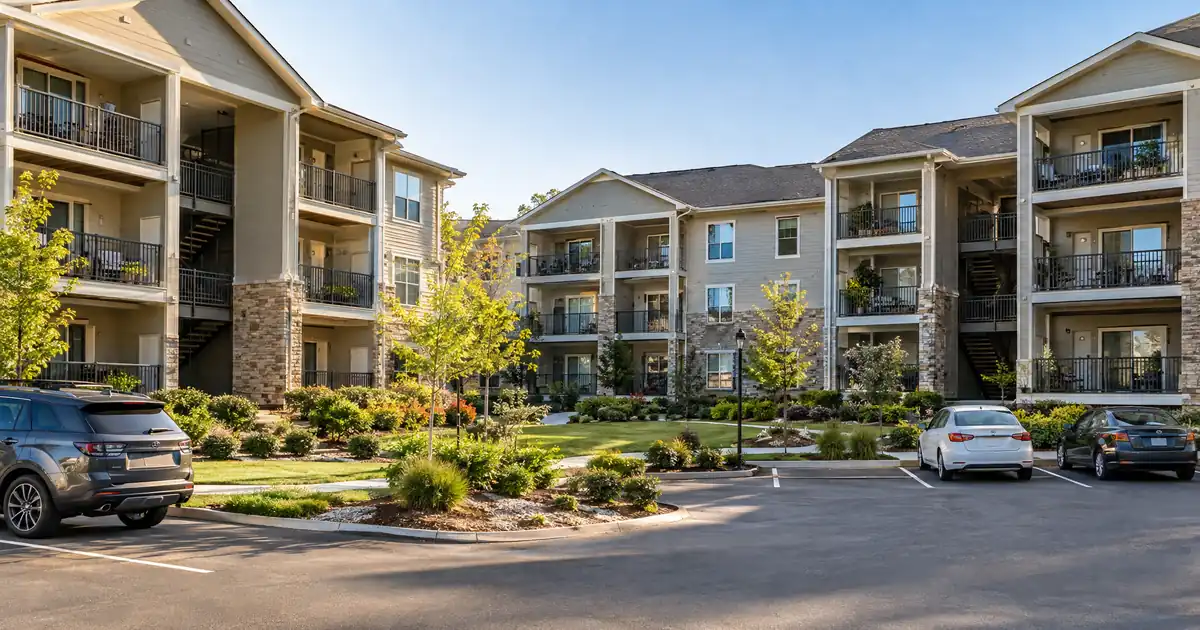
The Quick Read: A DSCR lender runs two separate reviews on an Airbnb condo in a beach complex: one on the unit’s income and one on the building’s risk, and a strong unit can still fail on a weak building. Across the wholesale network Lendmire works with, both reviews happen before leverage is set.
- The unit review asks which income evidence is used, then divides it by the full housing payment, including HOA dues.
- The building review reads the HOA budget, reserves, delinquencies, insurance, litigation, and rental mix.
- Many Airbnbs in one complex do not make a condotel. Front desks, rental pools, and a hotel-style management agreement do.
- Short-term-rental purchases typically reach 75% LTV on the strongest files, and a 640 score is the usual floor.
- Clearing 1.00 on the ratio is not the same as positive cash flow.
How does a lender look at a beach complex full of Airbnbs?
A lender looks at three layers in order: the building, the unit, and the borrower. Most files stall at the first layer, not the second. Investors usually start with the unit, because that is where their spreadsheet lives.
Short-Term Rental Calculator
Run the STR numbers in your market
Rate source: Freddie Mac 30-yr average via FRED® — Federal Reserve Bank of St. Louis · effective Oct 22, 2026
Prefilled with starting assumptions — enter your nightly rate, occupancy, taxes, and insurance for a more accurate picture.
Short-term rental income is documented with a 12-month history or a market data report. Program parameters update from Lendmire’s centralized guideline source.
As of Oct 22, 2026 · General Freddie Mac market benchmark, not a Lendmire loan offer. Nightly rate, occupancy, taxes, and insurance are editable estimates. Qualifying income for short-term rentals varies by program — some use appraisal market rent, others use documented STR history or projections — and is confirmed in underwriting. Not a Loan Estimate, approval, or commitment to lend. Program availability and eligibility are subject to lender guidelines, credit approval, property review, and underwriting.
The building layer asks whether the project is a normal condo with many rentals or something closer to a hotel. The unit layer asks what income the lender will count and whether it covers the payment. The borrower layer is credit, hosting history, reserves, and how the loan is titled. Entity ownership, such as an LLC, is available subject to lender program eligibility.
Here is the catch. A beach complex concentrates all three risks in one place. The units share the same storms, the same season, the same insurance pool, and the same management company. A lender reads that as correlated risk, which scattered single-family rentals do not carry.
For the broader mechanics behind these steps, the complete DSCR loans guide covers qualification from the ground up. This piece stays with what changes when the collateral is one condo in a beach complex.
What does the lender test on the unit?
On the unit, the lender divides the income it accepts by PITIA: principal, interest, taxes, insurance, and association dues. Condos add the dues line to the denominator, and that line is easy to forget when pricing a deal.
The harder question is which income counts. Across the network, programs generally take one of three routes:
- Documented history. Twelve months of platform, property-manager, or bank-deposit records. This fits the roughly 12 months of hosting history that short-term-rental programs usually expect.
- A third-party projection. A market-data estimate for the unit, usually reduced before it is used.
- A long-term rent fallback. The appraiser’s monthly market rent for the unit.
Which route applies, and how large any reduction is, depends on the program and the lender. It is not the appraiser’s call. McKissock’s appraisal education makes this point directly: the rent schedule form records monthly rent, not nightly rent or business income, and the lender decides how income is counted. It also says appraisers cannot multiply a nightly rate by 30 to get monthly rent. Investors who do that math in their head are working with a number no appraiser will produce.
The form itself is a live debate. Fannie Mae’s appraiser guidance says Form 1007 documents monthly market rent for conventional lending and can be used on condominium investment properties. That is an agency form, and it is useful here only as a vocabulary point. An opinion piece in HousingWire written by a private-lending executive argues that forcing short-term-rental income into that form can produce artificially low ratios. Treat that as an argument, not a rule. It does explain why a unit can clear on documented hosting history and miss on the long-term rent fallback.
The appraisal still sets value, and value sets LTV. A short-term-rental unit is valued like a similar non-rental unit, since furnishings and business income sit outside the real property value.
Ask the program which income method it uses before you write an offer. That one question prevents more surprises than any other on the unit side.
Short-term rental rules can vary by city, county, HOA, and property type, so investors should confirm local rules before relying on projected rental income.
What does the lender read in the condo questionnaire?
The condo questionnaire is the lender’s window into the building. TheHOAGuide explains that the agency versions are Form 1076 for Fannie Mae and Form 476 for Freddie Mac, and that they cover completion status, ownership concentration, delinquent assessments, litigation, insurance, deferred maintenance, and reserves. Non-QM lenders often use their own version, but the topics rhyme.
Questionnaire completeness matters as much as the answers. A blank line or a property manager who answers only half the form creates a gap, and a lender with a gap pends the file.
| Question area | What the lender looks for | How it moves the file |
|---|---|---|
| Ownership mix | Share of owner-occupied vs. rented units | High investor share can trim leverage |
| Delinquent dues | Units behind on assessments | High delinquency can end the review |
| Reserves | Funded reserve line in the budget | Thin reserves raise assessment risk |
| Litigation | Suits over defects or safety | Structural suits are the hardest to clear |
| Insurance | Master policy scope and limits | Gaps can raise dues or stall the file |
| Rental program | Pool, desk, or management tie-ins | Hotel traits change how the project is classed |
The order matters. Litigation and delinquency answers can end a review before anyone looks at the unit’s income. Ownership mix and rental-program answers usually move leverage and terms instead of ending the file.
When does a heavy Airbnb building become a condotel?
A building becomes a condotel when it operates like a hotel, not when many owners list on booking sites. Hotel operations are the test: a front desk, a rental pool, a central management agreement. Listing volume alone is not.
Fannie Mae’s guide on ineligible projects is a useful contrast, even though it does not govern DSCR loans. It lists traits that mark a project as a hotel:
- registration or front-desk services, with rentals on a daily or short-term basis;
- daily cleaning and central key systems;
- voluntary rental-pooling or revenue-sharing agreements with the HOA or a management company;
- management by a company that also books short-term rentals;
- a name or marketing that presents the project as a hotel, resort, or investment opportunity.
It also lists a resort-area location among the factors, which is why beach complexes draw extra attention. Those are agency screens. A DSCR lender applies its own project review, so a building that fails the agency test can still be reviewable, with leverage and terms adjusted. The agency list simply shows what a non-QM project reviewer will notice first.
A mandatory rental pool or owner-use limits read as the most hotel-like. A voluntary pool still gets noticed. The practical point is to find out which traits the building has before contract, not after.
The label “non-warrantable” is the same story. Warrantable status is a concept from agency selling rules. On a DSCR file it is a reason for closer review, not an automatic denial.
Does the number of Airbnb units in the complex matter?
Yes, it matters, though not as a single cutoff. A heavy rental share affects the building review and, separately, the reliability of your income.
On the building side, a high investor share shapes the questionnaire answers and can reduce leverage. On the income side, three things happen when many near-identical units compete in one complex:
1. Competing listings. Neighbors with the same floor plan and the same view undercut each other on nightly price. A projection built on average rates for the complex may overstate what your unit earns.
2. Shared seasonality. Every unit in the building has the same slow months. A fixed monthly payment against uneven income is the central cash-flow risk, and the whole complex feels it at once.
3. Shared amenities and rules. One pool closure, one elevator outage, or one rule change on rental length hits every unit together.
Documented hosting history for your own unit is the best defense. It shows what this unit earned in this building through a full cycle of seasons. A projection says what a unit might earn. A track record says what it did.
Lenders notice when the projection sits well above the unit’s actual deposits. Expect that gap to get questions.
How do HOA dues and assessments change the ratio?
Dues sit in the denominator, so every increase lowers the coverage number without changing the rent. A special assessment, once added to the payment, can pull a borderline file below the program floor.
Beach complexes carry heavy association costs: building envelope work, pools, elevators, and a master insurance policy that reflects coastal exposure. Those costs flow through dues. When reserves are thin, the association funds repairs by assessment instead.
Read the budget the way the lender will. Look at the reserve line, any approved or proposed assessments, and whether the master policy has changed. Dues that rose sharply in recent budgets suggest the association is catching up on deferred costs.
What if you own more than one unit in the complex?
Owning several units in one building stacks risk twice. It can concentrate ownership inside the project review, and it puts your portfolio exposure into a single set of walls, a single insurance policy, and a single season.
The agency contrast here is the ownership-concentration test buyers apply to projects. It does not set DSCR limits, but it shows why a lender asks how many units one owner holds. Programs differ on how they treat a borrower’s own share. Some lenders in the network treat each unit as its own loan with its own review. Others look harder at the combined exposure.
If you plan to buy more than one, raise it up front. Lendmire’s piece on documenting beach condos in one complex walks through the paperwork for that situation.
One beach building, traced end to end
The easiest way to see the logic is a file walk-through. Everything below is hypothetical and uses ratios only.
Scenario one: clean building. An investor buys a unit in a beach complex. The questionnaire shows funded reserves, low delinquency, no structural litigation, and no rental pool or front desk. The investor has more than 12 months of hosting history and a credit score above 640. The exact numbers vary by lender and program and follow a full review of property, leverage, and credit.
| Step | What the lender does | Result |
|---|---|---|
| Building review | Reads questionnaire and budget | Passes as a standard condo |
| Income method | Uses documented hosting history | Supports the rent figure |
| Ratio | Divides income by PITIA with dues | About 1.25x (modeled) |
| Leverage | Applies the short-term-rental purchase tier | Up to 75% LTV |
Scenario two: same unit, worse building. The unit income and ratio do not change. The questionnaire now shows a voluntary rental pool and a pending assessment. The assessment, once added to the payment, drops the modeled ratio from about 1.25x to near 1.05x. The rental pool puts the project in closer review.
Same unit, same borrower, different file. The lender may reduce leverage, ask for more reserves, or decline that project. If coverage lands under 1.00, programs below that line exist through select lenders in the network, with leverage and terms adjusted. Qualification stays subject to lender guidelines, credit approval, and property review.
Why do these files stall?
These are the usual causes, roughly in the order they surface:
1. An incomplete questionnaire. The manager answers half of it or sends the wrong form.
2. Litigation or delinquency in the building. Either can end the project review.
3. Hotel traits. A rental pool, a front desk, or a management agreement that books stays.
4. An income method mismatch. The deal clears on a projection but not on the method the program uses.
5. A late assessment. A special assessment lands during review and lowers the ratio.
6. HOA rules that limit nightly rentals. The income you modeled is not permitted in that building.
DSCR vs. conventional financing
There are two common ways to finance an investment property, and they qualify you differently — here’s how investors weigh them.
Why investors choose it
- Qualifies on the property’s rental income — no personal tax returns, W-2s, or pay stubs needed to document income.
- No personal debt-to-income ceiling to clear, so existing mortgages and obligations don’t cap your borrowing the same way.
- Can be closed in an LLC, keeping the property inside a business entity.
- Built for scaling — not held to the limit on number of financed properties that conventional financing applies.
- Underwriting centers on the deal: generally qualifies when the rent covers the payment, a 1.00x coverage ratio being a common baseline (confirmed in underwriting).
- Designed specifically for investment property, including long-term and, where the program allows, short-term rentals.
Where it’s strong
- Often the lowest ongoing financing cost for a buyer who fully qualifies on personal income — a fit for a first property or a cost-first purchase.
Trade-offs for investors
- Requires full personal income documentation and must fit within a debt-to-income limit — salary, existing debts, and other mortgages all count.
- Typically held in your personal name rather than a business entity.
- Caps how many financed properties you can carry, which can become a ceiling as a portfolio grows.
- Evaluates you as a borrower as much as the property, which usually means more paperwork.
How investors usually choose: a first or single property often optimizes for the lowest financing cost; portfolio builders often optimize for leverage, vesting in an LLC, and scaling past conventional caps. The right answer depends on your goals, the property, and current guidelines — both paths run through select lenders in Lendmire’s wholesale network, with eligibility and terms confirmed in underwriting.
What should you request before making an offer?
Ask the association for the following before you go under contract:
- the current budget and reserve schedule;
- the master insurance certificate;
- any approved or proposed special assessments;
- the rental rules in the declaration, including minimum stay;
- litigation disclosures;
- a completed questionnaire from the manager;
- twelve months of income records for the unit, if you buy a running rental.
If the answers are bad, you have options: a different building, a restructured deal with lower leverage, or a different lender in the network. A bad questionnaire after you have closed on a contract has no good fix.
What do the network’s short-term-rental parameters look like?
These are typical ranges across select wholesale-network lenders, subject to lender guidelines and not a commitment to lend.
On a short-term-rental purchase, leverage tops out at 75% LTV on the strongest files. On a short-term-rental refinance or cash-out, the ceiling is around 70%. A 640 credit score is the usual floor, and lenders typically expect about 12 months of hosting experience. On a short-term-rental purchase, the coverage floor is 1.00. On a short-term-rental refinance, the floor is also 1.00. Loan amounts run up to $3,000,000 on standard programs.
Reserves vary by lender, leverage, loan size, and transaction type. About six months of PITIA is common, and larger loans typically step up.
A bigger down payment lowers the payment and can lift the ratio. It does not erase leverage caps, credit floors, reserve rules, or building eligibility. The strongest files clear both tests: enough equity and enough rental coverage.
DSCR also compares rent to PITIA only. Vacancy, cleaning, management, utilities, and repairs sit outside the calculation. HousingWire’s opinion piece names cleaning and management fees among the variables that drive real short-term-rental income. A ratio above 1.00 shows the rent covers the payment. It does not show profit.
Exit risk deserves a sentence too. Buildings with high investor share or litigation can be harder to resell to buyers who need conventional financing. Tax treatment varies; consult a qualified professional.
Key Terms Defined
PITIA: Principal, interest, taxes, insurance, and association dues, the monthly obligation the rent is measured against.
DSCR (debt service coverage ratio): Documented rental income divided by PITIA, expressed as a multiple such as 1.25x.
Condo questionnaire: A form the association completes about finances, ownership mix, litigation, and insurance for the lender’s project review.
Warrantable: An agency selling-rule label for projects that meet agency eligibility screens, not a DSCR requirement.
Condotel: A project that operates like a hotel, with traits such as a front desk, rental pool, or central booking.
Rental pool: An arrangement where owners share rental revenue through the HOA or a manager.
Frequently Asked Questions
Does a high investor share kill a DSCR loan on a beach condo?
Not by itself. A high investor share draws closer project review and can reduce leverage, but DSCR lenders run their own review instead of the agency screens. Litigation, heavy delinquency, and hotel operations are more likely to end a file than ownership mix alone.
Is a non-warrantable building the same as a condotel?
No. Non-warrantable is an agency label with many causes, such as concentration, litigation, or commercial space. A condotel is a building that operates like a hotel. A building can be non-warrantable without any hotel traits.
Does clearing 1.00 mean the unit cash flows?
No. The ratio compares rent to PITIA only. Vacancy, cleaning, management, utilities, and repairs fall outside it, and short-term rentals carry more of those costs than long-term leases.
Can I buy several units in one complex?
Often yes, but lenders look at concentration inside the project and across your own exposure. Disclose the plan early so the file is built for it. Programs differ on how they treat multiple units, so the structure may change from one lender to the next.
What if the HOA limits short-term rentals?
Then the income you modeled may not be usable. The declaration must allow nightly rentals for that unit, and local rules apply too. A lender may fall back on long-term market rent, which can lower the ratio.
The Next Step
If you are buying or refinancing a rental property and want to see how the numbers work, Lendmire can help you compare DSCR loan options based on the property income, credit profile, leverage, and investor goals. Lendmire is a broker that arranges financing through select lenders in its wholesale network across 41 markets, including Washington, D.C. For a sense of how short-term income gets counted in a building like this, see how a DSCR lender counts short-term rental beach condos in one complex.
For current guidelines and terms, see Lendmire’s DSCR loan programs page.
About Lendmire
Lendmire is a DSCR-focused mortgage brokerage, NMLS# 2371349, placing investor loans across 41 markets, including Washington, D.C. DSCR eligibility is generally reviewed by the lender around a property’s rental income rather than personal income documentation, which fits LLC-held rentals, self-employed investors, and portfolios scaling past conventional financed-property limits. Scotsman Guide named Lendmire a Top Mortgage Workplace in both 2025 and 2026.
Get Started
Ready to find the right loan for you?
In about 30 seconds you can review financing options available for your investment property. No commitment required.
Informational only. Not a Loan Estimate, approval, or commitment to lend. Program availability and eligibility are subject to lender guidelines, credit approval, property review, and underwriting.
References
1. McKissock on Form 1007 and short-term rental appraisals
2. Fannie Mae appraiser update on Form 1007
3. HousingWire on short-term rentals and the appraisal playbook
4. TheHOAGuide on the condo questionnaire
5. Fannie Mae Selling Guide on ineligible projects
This article is part of Lendmire’s short-term rental loan program — full qualification details, guidelines, and scenarios live on the program page.
Related reading: Is a DSCR Loan the Usual Exit for a Kept Single-Family Flip? · Own Loan vs Portfolio DSCR Loan for Airbnbs in Three or More Markets · DSCR Portfolio Closing Requirements for a Package With Turnover
Brandon Miller
Founder & CEO, Mortgage Loan Originator, Lendmire LLC
- Mortgage Loan Originator · NMLS# 1129696 · Verify on NMLS Consumer Access
- North Carolina Real Estate Broker · License# 343312 · Verify on NCREC
- North Carolina Insurance Producer · License# 19053198 · Property, Casualty, Life, Health · Verify on NAIC SBS
- Lendmire LLC · Firm NMLS# 2371349 · Verify firm licensure
Disclosure information. Lendmire is a state-licensed mortgage brokerage under NMLS# 2371349. Lendmire is not a depository institution, direct lender, or financial advisor — all loans referenced are placed through wholesale lender partners and are subject to each lender's underwriting standards. This article is provided for general informational purposes and is not a commitment to lend, nor does it constitute financial, legal, or tax advice. Loan programs, terms, rates, and qualification standards change without notice and depend on borrower profile, property type, and the state in which the subject property is located. Equal Housing Opportunity provider. NMLS Consumer Access: nmlsconsumeraccess.org.