
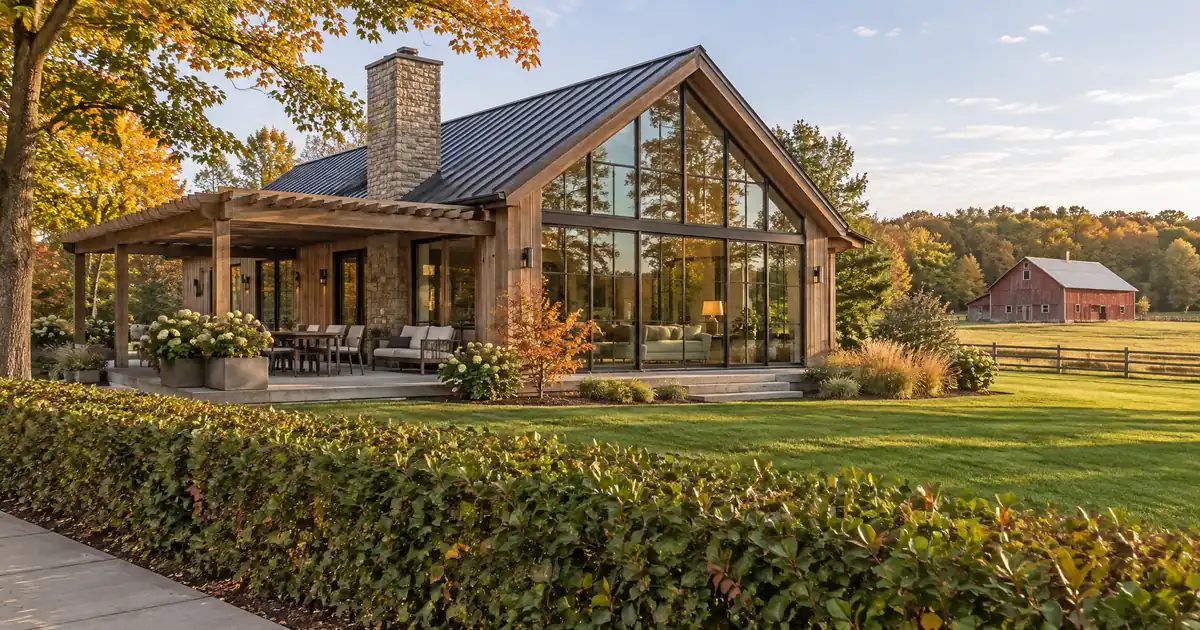
The Quick Read: The best program for a short-term rental on acreage depends on three things: how the appraiser treats the land, how the lender handles rural property, and how the hosting income is documented. No single program wins every file. Cash-out is available through select lenders in Lendmire’s wholesale network, subject to lender guidelines.
- Cash-out on a short-term rental typically runs up to 70% LTV, with a 640+ credit score and about 12 months of hosting history.
- The coverage floor on a refinance is 1.00 on most of these files, and clearing it does not mean the property cash flows.
- Excess land can be valued separately or left out, which shrinks the value the loan is sized on.
- Acreage limits are lender policy, not law, so the same parcel can fit one program and miss another.
- Loan size can trigger a rural flag before acreage does.
Land is where these files get decided. Most investors expect the rental income to be the hard part. On acreage, the appraisal often comes first.
DSCR Cash-Out Calculator
Run the cash-out numbers in your market
Rate source: Freddie Mac 30-yr average via FRED® — Federal Reserve Bank of St. Louis · effective Nov 5, 2026
Prefilled with starting assumptions — enter your property’s value, balance, taxes, and insurance for a more accurate picture.
Program parameters update from Lendmire’s centralized guideline source. Taxes and insurance are editable estimates.
As of Nov 5, 2026 · General Freddie Mac market benchmark, not a Lendmire loan offer. Property value, balance, taxes, and insurance are editable estimates. Maximum loan-to-value varies by lender, program, property type, and seasoning. Not a Loan Estimate, approval, or commitment to lend. Program availability and eligibility are subject to lender guidelines, credit approval, property review, and underwriting.
DSCR loans are designed for non-owner-occupied investment properties. Because they are business-purpose investor loans, they are reviewed differently from a standard owner-occupied mortgage. Qualification runs primarily on property-level rental income covering the payment, subject to lender guidelines. Lendmire is a broker. It arranges these loans through select lenders in a wholesale network across 40 states plus Washington, D.C. For the basics, see the complete DSCR loans guide.
Key Terms Defined
Cash-out refinance: a new loan on a property you own that pays off the old loan and returns the leftover equity as cash.
DSCR (debt service coverage ratio): monthly rent divided by PITIA, which is principal, interest, taxes, insurance, and association dues.
Seasoning: the minimum time you must own the property before a lender allows cash-out. About 6 months is the common expectation across the network.
Excess land: acreage beyond what is typical for the area, which an appraiser may value separately or exclude.
Form 1007: the appraiser’s single-family rent schedule, which reports monthly market rent.
Why Is There No Single Best Program?
Because the answer comes from the file, not the product. Two parcels with the same revenue can produce different loan amounts. The appraiser may value the land differently. The lender may read “rural” differently. The income method may differ too.
Lenders in the network differ on all three. That is the reason a broker shops the scenario instead of pushing one product. The best program for your situation depends on the acreage, the loan size, the credit profile, and how much hosting history you can document.
Acreage limits are set by each lender’s policy. They are not federal rules. A cap on acreage, where one exists, is an investor-program overlay. Don’t assume a number you heard about conventional loans carries over. Conventional guidelines don’t govern these files.
How Does Underwriting Treat the Land?
The appraiser separates the house and the land that supports it from the excess land. The house and its supporting site count toward value. Land beyond what is typical for the area may be valued at raw-land prices or left out.
The appraiser will also need comparable sales. Rural markets often lack recent sales nearby, so the report may use older or more distant comps. That can be acceptable when the report explains why those comps were chosen.
Here is the catch. Whatever the appraiser leaves out of value, the loan can’t count either. Leverage applies to appraised value, not to what you paid or what the parcel feels worth. If 10 acres appraise as a house plus a modest site, the rest adds little to the base.
The cleanest fix is a legally separate parcel. Some programs want excess land split off before they will exclude it cleanly. If a split is realistic, raise it before the appraisal is ordered.
How Is Short-Term Rental Income Counted?
Lenders generally use one of three routes. Which are available depends on the program.
1. Trailing 12-month actual income. Platform payout statements and bank deposits show what the property earned. This is the strongest evidence, and it lines up with the roughly 12 months of hosting history these files usually expect.
2. A market income projection. A market report can estimate income from comparable listings. Programs differ on whether they accept it, and some apply a haircut. Projections can miss. Actual occupancy sometimes lands well above or below what a report predicted.
3. The appraiser’s rent survey. This is where rural files stumble. Form 1007 asks for monthly market rent based on comparable leases. Fannie Mae’s appraiser update says the form is not meant to estimate a nightly short-term rental fee, and that multiplying a nightly rate by 30 is incorrect. McKissock’s appraisal education piece agrees that the form documents monthly rent for one-unit properties, not short-term rates.
Appraisers who understand short-term rentals often add a labeled narrative analysis instead. Class Valuation, an appraisal management firm, recommends a short-term rental projected income analysis addendum for this purpose. Treat that as an industry view, not a rule. For two-to-four unit properties, the appraisal uses Form 1025 instead of 1007.
On acreage, the rent survey is thin. Few long-term leases exist nearby. If the appraiser can’t find supportable monthly rent comps, the income side leans harder on your own history. Seasonal bookings are fine, but the statements should cover a full cycle.
Most programs also apply an expense adjustment to gross short-term income before running the coverage ratio. Ask which income figure a lender will use, because the answer moves the ratio.
What Does the DSCR Calculation Show?
It shows whether rent covers the payment. Divide monthly rental income by PITIA. At 1.00, rent equals the payment. Select programs start at 1.00 for short-term rental refinances. A separate select-lender path takes coverage below 1.00, with leverage and terms adjusted. Stronger ratios open better pricing and more leverage.
Clearing 1.00 is not positive cash flow. Repairs, vacancy, management, utilities, and capex sit outside the calculation. Rural short-term rentals carry real operating cost: long driveways, well and septic upkeep, and cleaning crews who travel. The ratio ignores all of it.
A larger new payment lowers the ratio. A property already near 1.00 has little room to take on more cash-out. Pulling less cash can keep the file inside the floor.
What Are the Program Parameters?
These are typical ranges across select lenders in the network. They are not guarantees, and every file is underwritten individually.
| Factor | Short-Term Rental Cash-Out |
|---|---|
| Max leverage | Up to 70% LTV |
| Credit score | 640+ |
| Coverage floor | 1.00 on refinances |
| Hosting history | About 12 months |
| Seasoning | About 6 months common |
| Loan size | Up to $3,000,000 standard |
| Reserves | Commonly around 6 months of PITIA |
Reserves vary by lender, leverage, loan size, and transaction type. Loans above $1,500,000 typically step up. Cash-out proceeds from the same loan generally don’t count toward reserves, so plan to show them separately.
Purchases run higher. Short-term rental purchase leverage reaches up to 75% LTV, which is a different transaction with a different ceiling. Standard long-term rentals reach around 75% on cash-out. Each figure is subject to lender guidelines and a complete review of property type, leverage, and credit.
A larger down payment or a lower cash-out request lowers the payment and can lift the ratio. It does not erase the leverage cap, the credit floor, the reserve rules, or property eligibility. The strongest files clear both tests: enough equity and enough rental coverage.
Where Does Acreage Break the General Rule?
Several places. These are the edge cases that decide files.
The dollar line can beat the acreage line. A five-acre property can be fine at one loan size and flagged rural at a higher one. The land did not change. The loan amount did. Check both.
Above $3,000,000. Rural property is excluded and cash-out is not available. Rate-and-term is the only refinance at that size.
Agricultural use. The test is whether the property is residential in nature and not primarily farmed. Working farms need a rural or agricultural lender. A home with some pasture is not a farm. A home with a cattle operation may be.
Outbuildings and second dwellings. A guest house can help an income story, but the appraiser decides whether it counts and how. A second dwelling may change the unit count and the appraisal form.
Ineligible structures. Manufactured homes, log homes, and barndominiums are not offered in the network’s DSCR programs. Many rural properties are exactly these. Confirm the structure type before anything else.
Seasoning and delayed financing. Seasoning is lender policy, not law. On a recent purchase, delayed financing sizes the loan on documented cost rather than a new appraisal. Settlement statements prove that cost.
Local permission. Short-term rental rules can vary by city, county, HOA, and property type, so investors should confirm local rules before relying on projected rental income. Rural permission is not assumed. Lenders may want it documented for the specific property.
How Does the Cash Actually Get Calculated?
Leverage cap times appraised value gives the maximum loan. Subtract the payoff and costs. What remains is the cash.
On a 70% cash-out, that means the appraisal has to come in meaningfully above the payoff before any cash returns. If the appraiser values excess land at zero, the base shrinks and the cash shrinks with it. A short appraisal can turn an expected cash-out into a payoff-only refinance. Leverage, reserves, and pricing vary by lender and program; the final terms follow the full file review.
Run a scenario. Picture an investor who owns a cabin on 12 acres, with the appraiser supporting value on the house and a modest site only. The investor expected cash based on the whole parcel. At 70% of the smaller number, the loan barely clears the existing balance. Same house, same bookings, no cash. Land can produce exactly this kind of surprise.
Run it backward before you apply. Estimate value on the house and supporting site alone, apply the leverage cap, and subtract the payoff. If cash still shows up, the land is a bonus.
What Documents Should You Gather?
- Platform payout statements and bank deposits covering a full 12 months.
- Entity documents if the property is held in an LLC, subject to lender program eligibility.
- Proof of local short-term rental permission for the property.
- Current insurance that covers rental use, with the land and any outbuildings listed.
- A survey or parcel map, plus any split or lot-line records.
- Reserves documentation held separately from expected proceeds.
- Payoff statement, title information, and well and septic details.
Missing entity papers and unclear insurance are the quiet delays. Hand them over at the start.
What Mistakes Should You Avoid?
1. Assuming the whole parcel counts toward value.
2. Assuming the appraiser’s rent survey will capture nightly income.
3. Pulling the maximum cash on a property already near the coverage floor.
4. Skipping the structure check on barndominiums, log homes, and manufactured homes.
5. Treating a clear coverage ratio as proof the property cash flows.
6. Ignoring that loan size alone can trigger a rural flag.
How Do You Find the Right Fit?
Match the property to the program before choosing the income method. Check acreage, rural flags, and loan size first. Then pick the income method and confirm the appraiser has short-term rental experience. A broker that shops multiple wholesale lenders can compare how each treats land and projections. That comparison is the work.
If you are buying or refinancing a rental property and want to see how the numbers work, Lendmire can help you compare DSCR loan options based on the property income, credit profile, leverage, and investor goals. Call 828-256-2183 or request a quote.
Frequently Asked Questions
Is there a maximum acreage for a short-term rental cash-out refinance?
No universal one exists. Acreage limits are lender policy, so they vary across the network. Loan size matters as well, since a property can be fine at one balance and flagged rural at a higher one. Above $3,000,000, rural property is excluded and cash-out is unavailable.
Does the extra land increase the loan amount?
Only to the extent the appraiser counts it. Land beyond what is typical for the area may be valued separately or excluded. Because leverage applies to appraised value, excluded land adds nothing to the loan base. Splitting it into a separate parcel is the cleanest way to remove it.
Can the appraiser’s rent estimate capture my nightly income?
No. Form 1007 reports monthly market rent from comparable leases and isn’t designed to estimate nightly fees. Short-term income is usually documented through your 12 months of actual history or a projection, depending on the program.
What credit score and leverage apply?
Short-term rental cash-out typically runs up to 70% LTV with a 640+ score, subject to lender guidelines. Purchases on short-term rentals reach up to 75%. Stronger scores and coverage can improve terms, but they don’t lift property-eligibility limits.
Can I use a manufactured home or barndominium on acreage?
No. Confirm the structure type early.
For how equity extraction works on an investment property, see Lendmire’s guide to cash-out refinance on an investment property.
About Lendmire
Lendmire is a non-QM mortgage brokerage (NMLS# 2371349) arranging DSCR investor loans in 41 markets, including Washington, D.C. DSCR eligibility is generally reviewed around property-level rental income rather than personal income, subject to lender and program guidelines, a fit for self-employed investors and LLC-owned portfolios. Lendmire was recognized as a Scotsman Guide Top Mortgage Workplace in 2025 and 2026.
Get Started
Ready to find the right loan for you?
See your offer in seconds. No credit pull, no obligation.
Informational only. Not a Loan Estimate, approval, or commitment to lend. Program availability and eligibility are subject to lender guidelines, credit approval, property review, and underwriting.
References
1. Fannie Mae Appraiser Update
2. McKissock’s appraisal education piece
3. Class Valuation, an appraisal management firm
This article is part of Lendmire’s investment property cash-out refinance program — full qualification details, guidelines, and scenarios live on the program page.
Related reading: Top Short-Term Rental Cash-Out Refinance Providers After Converting the Home to a Rental · Banks That Offer a Short-Term Rental Cash-Out Refinance on a BRRRR Rental After Rehab
Brandon Miller
Founder & CEO, Mortgage Loan Originator, Lendmire LLC
- Mortgage Loan Originator · NMLS# 1129696 · Verify on NMLS Consumer Access
- North Carolina Real Estate Broker · License# 343312 · Verify on NCREC
- North Carolina Insurance Producer · License# 19053198 · Property, Casualty, Life, Health · Verify on NAIC SBS
- Lendmire LLC · Firm NMLS# 2371349 · Verify firm licensure
Required disclosures. Lendmire (NMLS# 2371349) operates as a licensed mortgage broker, not a direct lender or depository. The discussion in this article is general in nature and should not be relied upon as financial, legal, or tax advice — every investment scenario is unique and should be reviewed by a qualified professional. Any loan inquiry is subject to lender underwriting, and this article is not a commitment to lend or a guarantee of approval. Mortgage rates, loan terms, and program guidelines vary by borrower, property, and state, and may change without notice. Equal Housing Opportunity. Verify licensure at NMLS Consumer Access.