
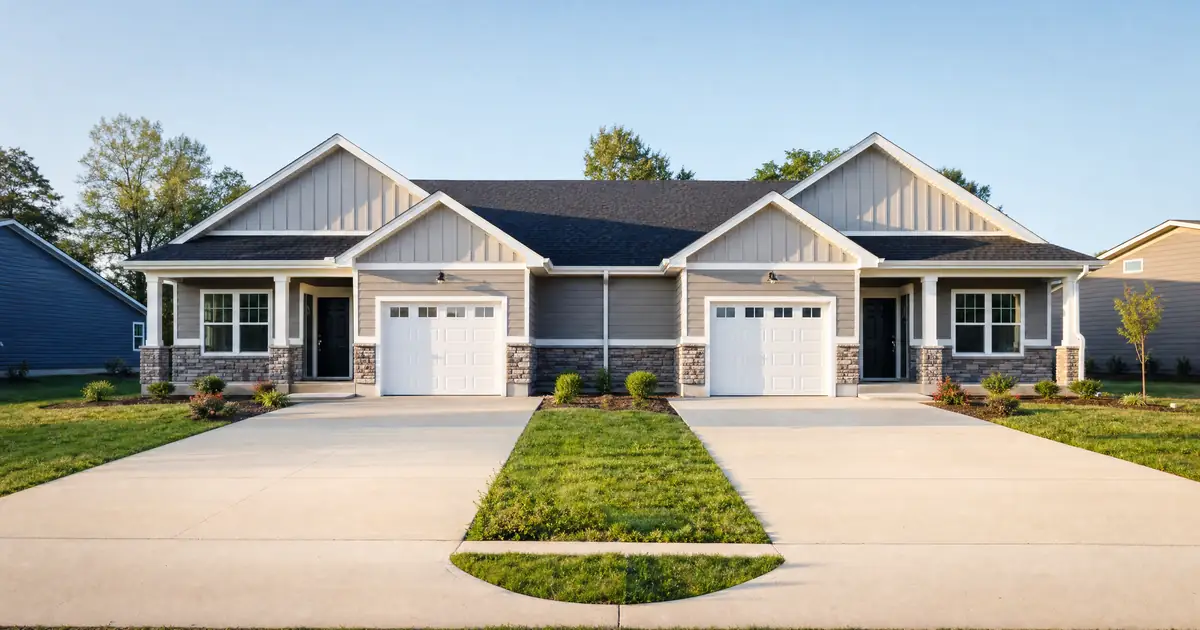
Buying A Duplex As Your First Investment Without Living In It — The Quick Read: Yes, you can buy a duplex as a pure rental and never move into either unit. Doing so shifts the loan out of the owner-occupied lane and into investment-property financing, where the property’s own rent — not your paycheck — carries the file. That’s the setup a DSCR loan is built for: a two-unit property that has to stand on its own income. The tradeoff is a bigger down payment, a stricter appraisal process, and zero flexibility to change your mind and move in later. This article is general information only and is not legal or tax advice.
Key Takeaways
- Skipping the move-in reclassifies the loan as business-purpose investment financing, not a personal mortgage.
- DSCR loans qualify the file on combined rent from both units against the payment, not on the buyer’s traditional personal-income documentation.
- An appraiser scores each unit’s rent separately, then underwriting uses the lower of that number or a signed lease — never whichever figure is bigger.
- Down payments run higher than an owner-occupied purchase, and coverage below full breakeven doesn’t vanish as an option — it just costs more in leverage and terms.
- Moving into even one side of the duplex, even for a short stretch, changes the loan’s legal category.
- None of the material below is legal or tax advice; occupancy and entity questions belong with a qualified attorney or CPA.
What Actually Changes When You Skip the Move-In
The math on a duplex looks completely different once you take yourself out of one of the units.
DSCR Calculator
Run the numbers in your market
Rate source: Freddie Mac 30-yr average via FRED® — Federal Reserve Bank of St. Louis · effective Aug 13, 2026
Prefilled with local estimates — enter your own rent or nightly figures, taxes, insurance, and HOA for a more accurate picture.
Program parameters update from Lendmire’s centralized guideline source. Taxes and insurance are editable estimates.
As of Aug 13, 2026 · General Freddie Mac market benchmark, not a Lendmire loan offer. Rent, nightly rate, occupancy, taxes, and insurance are editable estimates. Short-term rental figures are estimates only and vary significantly by season, property type, management approach, and local short-term-rental rules — confirm local regulations before relying on them. Qualifying income for short-term rentals varies by program — some use appraisal market rent, others use documented STR history or projections — and is confirmed in underwriting. Not a Loan Estimate, approval, or commitment to lend. Program availability and eligibility are subject to lender guidelines, credit approval, property review, and underwriting.
Buy a duplex to live in one side and rent the other, and the loan is a personal mortgage. Your income, your debt-to-income ratio, your traditional personal-income documentation — all of it lands in the file, same as any owner-occupied purchase. Skip the move-in entirely, and the property becomes a pure rental. The loan shifts into investment-property underwriting, where the borrower’s paycheck barely matters and the property’s own rent does the heavy lifting.
This is the fork in the road most first-time duplex buyers don’t realize exists until they’re already under contract. One path trades a smaller down payment for the requirement that you actually live there. The other trades a bigger down payment for total flexibility. No move. No lease-up delay. No disrupting your current housing to make the numbers work.
Investors who go the non-owner-occupied route typically land on a DSCR loan — a loan that qualifies the property based on whether its rent covers its own payment, rather than on the buyer’s personal income documentation. That’s the structure built for exactly this scenario: a rental that has to carry itself.
Key Terms Defined
- DSCR (debt-service coverage ratio): monthly rent divided by the monthly payment — a ratio at or above 1.00 means rent covers the payment.
- PITIA: principal, interest, taxes, insurance, and any association dues — the full cost of owning the property each month, not just the loan payment.
- LTV (loan-to-value): the loan amount expressed as a percentage of the property’s price or appraised value; a lower LTV means more money down.
- Non-owner-occupied: a property the buyer doesn’t live in for any meaningful stretch of the year — the classification that shifts a loan from personal to business-purpose underwriting.
- Business-purpose loan: financing for a property bought to produce rental income rather than to house the borrower.
- Seasoning: the waiting period a lender wants between buying a property and refinancing it.
- Reserves: cash left in the bank after closing, held as a cushion equal to a set number of months of PITIA.
These definitions are offered as general background, not as legal or tax advice.
How Does a Non-Owner-Occupied Duplex Actually Get Qualified?
DSCR loans are designed for non-owner-occupied investment properties. Because they’re business-purpose investor loans, they’re reviewed differently from a standard owner-occupied mortgage — property income first, personal income barely at all. Here’s the sequence.
The property gets underwritten, not the buyer. Instead of pulling W-2s and traditional personal-income documentation, underwriting divides the property’s monthly rent by its PITIA. Clear 1.00 or better on most programs and the file passes that coverage test — 1.00 is where a number of select programs across the network start, not a universal line or an industry standard, and stronger ratios open better leverage and terms.
Both units count, but separately. On a duplex, the appraiser evaluates each unit’s rent on its own using a two-to-four-unit income form, distinct from the single-family rent schedule used on a standalone house. That form, per McKissock, “differs from” the single-family version “in that it is used to assess duplexes, triplexes, and fourplexes” and factors in both rental income and comparable market value.
Underwriting uses the lower number, never the bigger one. If a unit has a tenant in place, the file compares the signed lease against the appraiser’s independent market-rent conclusion — and takes whichever number is lower. A rent roll that’s been quietly padded doesn’t survive this step.
A vacant unit runs on projected rent. No lease means no comparison. The appraiser’s market-rent estimate becomes the qualifying figure for that side of the building.
The payment side gets rebuilt, not copied. A seller’s current tax bill and insurance premium rarely transfer intact — taxes often reassess after a sale, and insurance is priced off the new owner’s coverage, not the old policy. PITIA in the file reflects what the buyer will actually owe. How those items are assessed is a question for a tax professional or licensed insurance agent, not something this article can answer.
The borrower certifies non-occupancy. Every DSCR file requires a signed statement that the borrower won’t live there. That certification is the paperwork version of the same occupancy test that decides whether a loan is personal or business-purpose to begin with.
The Numbers Investors Actually See
Across the wholesale network Lendmire works with, most non-owner-occupied duplex purchases land at 75%-80% LTV — 20%-25% down on a typical file. Worth scoping: those are the standard-program numbers for borrowers who already own a primary residence. A borrower without one generally qualifies through a select-lender renter-to-investor path — roughly 700+ credit, 70% maximum CLTV, a 1.15 coverage floor, and loans up to $1,000,000 — subject to lender guidelines. A handful of high-leverage programs stretch to 85% LTV, closer to 15% down, but those generally want a credit score of 700 or better. Credit floors run as low as 620 on the more flexible end of the network, with 660 the common ask for standard terms, and 700+ unlocking the strongest leverage tiers.
Reserves — cash held after closing — commonly run around 6 months of PITIA. Above roughly $1,500,000 in loan size, that tends to step up toward 9 months. Conservative rate-term refinances at modest leverage below that threshold sometimes see reserves waived, though that’s the exception, not the rule. Standard programs top out around $3,000,000, with smaller loan balances handled through select lenders built for that end of the market.
A bigger down payment lowers the monthly obligation and can lift the coverage ratio — but it doesn’t override a credit floor, a leverage cap, or a property-eligibility rule. The strongest files clear both tests at once: enough equity in the deal, and enough rental coverage to carry the payment with room to spare.
Worth sitting with: clearing 1.00 on the coverage ratio is not the same as positive cash flow. The number only measures rent against PITIA. Repairs, vacancy, property management, utilities, and capital expenses all sit outside that math — a duplex can clear 1.05 or 1.10 on paper and still cost its owner money once real operating costs show up. How those costs are treated on a return is a tax question, and nothing here should be read as tax advice.
Duplex files Lendmire sees across the network tend to follow a pattern. The unit with a tenant already in place almost always drives the coverage number, while the vacant or previously owner-occupied unit is where files stall waiting on a market-rent appraisal. A file walking in with at least one signed lease, even a short-term one, tends to clear underwriting with fewer rent-related questions than one leaning entirely on projected income for both sides.
For the full mechanics behind how that ratio gets built, the complete DSCR loans guide breaks down every input a lender pulls into the calculation. Investors weighing this against a conventional investment loan can find the structural tradeoffs in a comparison of DSCR loans versus conventional financing.
Where This Strategy Gets Investors in Trouble
Living in even one unit changes everything. This is the edge case that trips up more first-time duplex buyers than any other. The line separating a personal mortgage from a business-purpose one isn’t a marketing choice — it’s a factual test tied to actual occupancy. Under Regulation Z, the rule that governs consumer lending disclosures, credit used to acquire a rental property the borrower doesn’t occupy is treated as business-purpose regardless of the number of units involved, according to the Consumer Financial Protection Bureau. The same guidance draws a bright line on occupancy: a borrower who expects to occupy a property more than 14 days in the coming year can’t call it non-owner-occupied. Move into one side “just for a few months” while sorting out the other unit’s lease, and the file’s whole classification is at risk. This summary is general information, not legal advice — how the rule applies to a specific purchase is a question for an attorney.
Appraisal risk runs unit-by-unit, not lump-sum. A rent roll showing a healthy combined total from the seller doesn’t matter if the appraiser can’t independently support each unit’s own number. Walking both units before writing an offer — not skimming a trailing income summary — is the difference between a file that appraises clean and one that comes in short.
A vacant unit at closing adds uncertainty. Without a lease to lean on, the appraiser’s market-rent opinion is the only figure the file has for that side of the building. Land lower than expected, and the coverage ratio moves with it.
The PITIA rebuild can surprise buyers. A property carrying a low tax bill under the seller’s exemption or a long-held insurance policy can see both numbers reset higher post-sale, tightening the ratio the buyer was counting on.
Not every small multifamily property qualifies. Manufactured homes — single- or double-wide — along with log homes and barndominiums fall outside DSCR programs across the network. If a duplex-style property sits on a manufactured chassis, it’s not eligible under this structure no matter how the rent pencils out.
Coverage below 1.00 doesn’t disappear, but it isn’t free. Select lenders in the network will review files where rent doesn’t fully cover the payment, though leverage and terms adjust to compensate.True no-ratio qualification — where no coverage ratio is calculated at all — is available through select lenders in the network, generally for borrowers who already own a primary residence, with leverage and terms adjusted to match and every file subject to lender guidelines.
Duplex Ownership Paths At a Glance
| Factor | Owner-Occupied Purchase | Non-Owner-Occupied DSCR |
|---|---|---|
| Qualifying basis | Buyer income, W-2s, traditional income documentation | Property rent vs. PITIA |
| Typical down payment | Lower, program-dependent | Typically 20%-25% (75%-80% LTV) |
| Occupancy requirement | Must live in one unit | Buyer occupies neither unit |
| Rental income use | Partial credit for the rented side | Full rent from both units counts |
| Loan type | Personal, consumer-purpose | Business-purpose investment loan |
Under FHA’s owner-occupied rules, a duplex doesn’t face the same “self-sufficiency” rent test applied to three- and four-unit purchases — HUD’s own reference materials require net rental income to cover the full payment only on properties with three or four units, not two-unit buildings (HUD Single Family Housing Policy Handbook reference materials). That distinction only matters if occupancy is on the table. A duplex bought purely as a rental skips FHA owner-occupied underwriting altogether and runs on the coverage ratio described above.
Who This Fits — And Who It Doesn’t
This works for investors who already have stable housing and don’t want to move to make a first deal happen. It works for buyers comfortable putting more down in exchange for skipping personal income documentation — a path covered in more depth for self-employed and non-traditional-income buyers in buying a first investment property without conventional personal-income paperwork. It also suits investors who’d rather manage two rent rolls under one roof, one insurance policy, one property to maintain, than juggle two separate single-family rentals.
It doesn’t fit buyers short on cash for a bigger down payment who were counting on owner-occupied financing’s lower entry point. It doesn’t fit anyone who might want to move in “just in case” — that flexibility isn’t really there once a file is underwritten as business-purpose. And it doesn’t fit shoppers at the very low end of the multifamily market where a property turns out to be manufactured, log-built, or barndominium-style construction.
Investors weighing a duplex against other entry-level property types have options worth comparing. A deeper look at the multi-unit case generally sits in buying a duplex or triplex as a first investment, and buyers torn between a small multifamily property and a single unit with an HOA attached might find buying a condo as your first investment property useful for the comparison.
Down the road, once the property has seasoned — typically around 6 months of ownership on most cash-out files — an investor can pull equity back out at up to roughly 75% LTV, subject to lender guidelines. How that timeline plays out is covered in refinancing a rental property without a long seasoning wait.
Frequently Asked Questions
Can I buy a duplex purely as a rental and never live in either unit?
Yes. That’s the exact scenario a DSCR loan is built for — the loan gets classified as business-purpose investment financing, and the property’s combined rent from both units qualifies the file rather than the buyer’s personal income. Whether a particular purchase qualifies as business-purpose is a legal question for your attorney, not something this article can decide.
How do you qualify for a DSCR loan on a duplex you don’t live in?
Underwriting divides the property’s combined monthly rent by its PITIA and looks for coverage at or above 1.00 on select programs, alongside a credit profile that meets the program’s floor and reserves held after closing. The appraiser scores each unit’s rent separately, and underwriting takes the lower of the appraiser’s market rent or the signed lease. Requirements vary by lender and are subject to program guidelines.
What are the requirements for a non-owner-occupied duplex DSCR file?
Expect a signed non-occupancy certification, a two-to-four-unit appraisal income form covering both units, a rebuilt PITIA reflecting the new owner’s taxes and insurance rather than the seller’s, reserves commonly around 6 months of PITIA, and a property type that isn’t manufactured, log-built, or barndominium-style. All of it remains subject to lender approval.
Does a non-owner-occupied duplex require a bigger down payment than an owner-occupied one?
Generally, yes. Most non-owner-occupied duplex purchases land at 75%-80% LTV, meaning 20%-25% down on a typical file, versus the lower entry points sometimes available on owner-occupied financing. A handful of high-leverage programs reach 85% LTV for stronger-credit borrowers, subject to lender guidelines.
What happens if one unit is vacant when I close?
The appraiser’s market-rent estimate becomes the rent used for lender review figure for that unit, since there’s no lease to compare it against. That estimate feeds directly into the coverage ratio, so a lower-than-expected number can tighten the file’s leverage or terms.
Can I move into the duplex later and still keep the same loan structure?
Occupying the property, even temporarily, changes the loan’s underlying classification from business-purpose to personal, based on the same occupancy test lenders and regulators use. Investors who might want that flexibility should discuss it with their lender and their own attorney before closing, not after — this is not legal advice.
Is a 620 credit score enough to buy a duplex with a DSCR loan?
A 620 floor exists in parts of the network, but most programs are built around a 660 target for standard terms and leverage. Scores of 700 or higher typically unlock the strongest leverage tiers, including the higher-LTV programs.
About Lendmire
Lendmire (NMLS# 2371349) is a non-QM DSCR mortgage broker, not a direct lender. If you’re buying or refinancing a rental property and want to see how the numbers work, Lendmire can help you compare DSCR loan options based on the property’s income, credit profile, leverage, and investor goals. Lendmire arranges DSCR financing through select lenders in a wholesale network spanning 40 states and Washington, D.C. — and investors can reach the team at 828-256-2183 or request a quote to start the conversation. Scotsman Guide named Lendmire a Top Mortgage Workplace in both 2025 and 2026.
Tax treatment can depend on how the funds are used and how the property is held; investors should keep clear records and speak with a qualified tax professional before relying on any deduction.
This article is general information only. It is not legal, tax, accounting, or financial advice, and Lendmire does not provide legal or tax advice. Occupancy classification, appraisal outcomes, entity structuring, and program eligibility depend on the specific property, borrower, and lender involved, so investors should talk to a qualified attorney or CPA about their own situation before making occupancy or financing decisions. Loan approval is never guaranteed, and nothing here is a commitment to lend. Every scenario described is subject to lender approval and to borrower, property, and program guidelines, which can change.
Get Started
Ready to find the right loan for you?
In about 30 seconds you can review financing options available for your home or investment property. No commitment required.
Informational only. Not a Loan Estimate, approval, or commitment to lend. Program availability and eligibility are subject to lender guidelines, credit approval, property review, and underwriting.
References
1. McKissock — Form 1007’s Impact on Short-Term Rental Appraisals
2. Consumer Financial Protection Bureau — Regulation Z Commentary
3. HUD Single Family Housing Policy Handbook Reference Materials
This article is part of Lendmire’s DSCR loan program — full qualification details, guidelines, and scenarios live on the program page.
Related reading: Buying A Duplex Or Triplex As A First Investment · Buying a Rental Property While Living With Your Parents: DSCR Loans · Airbnb Cash Out Refinance While Renting Your Residence
Brandon Miller
Founder & CEO, Mortgage Loan Originator, Lendmire LLC
- Mortgage Loan Originator · NMLS# 1129696 · Verify on NMLS Consumer Access
- North Carolina Real Estate Broker · License# 343312 · Verify on NCREC
- North Carolina Insurance Producer · License# 19053198 · Property, Casualty, Life, Health · Verify on NAIC SBS
- Lendmire LLC · Firm NMLS# 2371349 · Verify firm licensure
Disclosure information. Lendmire is a state-licensed mortgage brokerage under NMLS# 2371349. Lendmire is not a depository institution, direct lender, or financial advisor — all loans referenced are placed through wholesale lender partners and are subject to each lender's underwriting standards. This article is provided for general informational purposes and is not a commitment to lend, nor does it constitute financial, legal, or tax advice. Loan programs, terms, rates, and qualification standards change without notice and depend on borrower profile, property type, and the state in which the subject property is located. Equal Housing Opportunity provider. NMLS Consumer Access: nmlsconsumeraccess.org.