
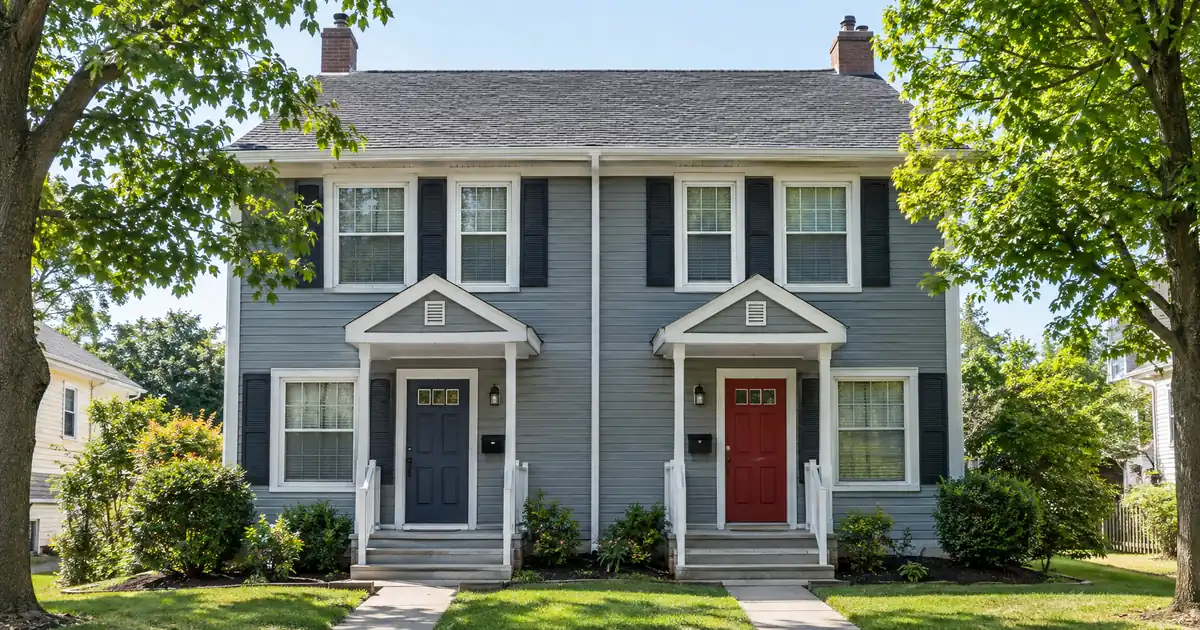
Buying A Duplex Or Triplex As A First Investment — The Quick Read: A duplex or triplex lets a first-time buyer collect several rent checks against one mortgage payment. That’s why people often see it as a stronger start than a single-family rental. But the financing splits hard based on occupancy. Live in one unit, and owner-occupied loan programs open up with lower down payments. Buy it as a pure rental, and the file runs through business-purpose DSCR underwriting instead. The unit count itself — two units versus three or four — changes things too. It changes the appraisal form. It changes the reserve requirement. And in some owner-occupied cases, it changes whether the property must prove it can pay for itself before a lender will touch it.
This article lays out the decision framework: how the mechanics actually work, where the tradeoffs sit, and who this strategy fits.
The Setup: Why Small Multifamily Gets Picked as a First Deal
Small multifamily — 2 to 4 units — is a real, well-documented slice of the U.S. housing stock. It’s not some workaround niche. The U.S. Census Bureau’s Rental Housing Finance Survey counted 2,323,000 properties in the “2 to 4 units” category. That’s out of 19,955,000 total rental properties nationally, holding 6,251,000 rental units. This scale matters for financing. Enough transactions happen that appraisers have a real pool of comps to pull from. And lenders on both sides of the occupancy line have standardized forms built just for this property type.
The core appeal is simple math: an income multiplier. One mortgage payment sits against two, three, or four rent rolls instead of one. A vacant unit in a duplex doesn’t zero out the property’s income. Compare that to a vacant single-family rental, where the income drops to nothing. In a duplex, the other unit keeps paying. That’s the mechanical case for small multifamily as a first deal, and it’s a real one. It’s also why the strategy shows up so often in investor circles as an entry point rather than an advanced move.
Key Takeaways:
- The financing lane splits entirely on occupancy — owner-occupied opens loan programs with lower down-payment thresholds, pure investment runs through DSCR.
- Appraisal treatment changes at 2 units — a different form governs rent used for lender review than on a single-family rental.
- HUD applies a stricter self-sufficiency test at 3-4 units that duplexes are exempt from.
- Crossing to 5+ units leaves residential financing behind entirely.
- DSCR coverage on a 2-4 unit property sums all unit rents against one PITIA figure.
How the Mechanics Actually Work, Step by Step
The mechanics run differently depending on whether the buyer will occupy a unit. That split matters more than most first-time buyers expect going in.
1. Decide the occupancy plan first. Living in one unit and renting the rest is the classic house-hacking model. It opens owner-occupied financing with lower down payment requirements. Buying purely as a rental, with no owner-occupancy, sends the file down a different path. It runs through a business-purpose DSCR loan instead. That loan qualifies mostly on the property’s rental income, not the borrower’s personal income paperwork, subject to lender guidelines.
2. Identify the unit count, because it changes the appraisal instrument. A single-unit rental gets qualified using the standard comparable rent schedule. A duplex, triplex, or fourplex uses a completely different form. It’s called the Small Residential Income Property Appraisal Report — known in the industry as Form 1025 (or Freddie Mac Form 72). This form combines a sales-comparison value opinion with a rental analysis for every unit in the building. Fannie Mae’s own selling guide spells out which form applies to which unit count. The form’s structure and purpose are also laid out directly in the official Form 1025 document itself.
3. Run the self-sufficiency test — if it applies. This is the biggest edge case in the owner-occupied lane. It only bites at 3 and 4 units. HUD’s own glossary defines Net Self-Sufficiency Rental Income as the rent left over after subtracting the greater of a vacancy/maintenance haircut or 25% of fair market rent. That leftover figure must cover the full PITI payment for a 3-4 unit FHA purchase. A duplex skips this test entirely. HUD’s archived reference guide confirms it: the self-sufficiency requirement is specific to three- and four-unit properties, full stop.
4. Budget the reserve requirement tied to unit count. In the owner-occupied 3-4 unit lane, HUD requires the mortgagee to verify three months of PITI in post-closing reserves. That’s specifically because the self-sufficiency test attached. In the DSCR lane, reserves run differently. Most files across Lendmire’s wholesale network land around 6 months of PITIA. That figure steps up toward roughly 9 months on larger loan balances above $1,500,000. Conservative rate-and-term files at modest leverage under that threshold sometimes see reserves waived by select lenders. Neither number is universal. It varies by lender, leverage, loan size, and transaction type.
5. Sum the rent roll for the coverage calculation, in the DSCR lane. Every unit’s rent gets added into one gross figure. That figure gets measured against the property’s total PITIA — principal, interest, taxes, insurance, and any association dues. Most programs across the network treat 1.00 as a starting floor for specific programs, not a universal minimum. That’s the point where the rent used for lender review equals the full monthly obligation. Stronger coverage above that floor tends to open better leverage and pricing tiers. Some lenders in the network will consider coverage below 1.00 with compensating factors — stronger reserves, lower leverage, or additional assets. Terms adjust accordingly, and this isn’t available across the whole network.
6. Get the appraiser’s number, not the seller’s advertised rent. Whether the file runs FHA or DSCR, one number usually drives the qualifying income. That’s the appraiser’s supported rent figure — not a borrower’s optimistic estimate or a seller’s listed lease amount. This applies especially when a lease can’t be independently verified. The lender still reviews that appraisal alongside actual leases or income documentation before the final number gets locked into underwriting.
The Duplex-vs-Triplex Line: Where the Real Divide Sits
The 2-unit/3-unit line matters more for owner-occupied financing than most buyers assume. Many think the 4-unit/5-unit line is the important cutoff. It isn’t — not for this. A duplex buyer under FHA financing never has to run the self-sufficiency math at all. Move up to a triplex or fourplex, and the story changes. The property has to prove — on the appraiser’s numbers, after a vacancy/maintenance haircut — that it can cover its own payment before the file clears. That’s a binary pass/fail test. There’s no flexibility for compensating factors. This is a meaningfully different underwriting posture than what a DSCR loan allows on the investment side.
| Factor | Duplex (2-unit) | Triplex/Fourplex (3-4 unit) |
|---|---|---|
| FHA self-sufficiency test | Not applied | Required — net rent must cover full PITI |
| FHA reserve requirement | Standard | 3 months PITI verified post-closing |
| Appraisal form (both lanes) | Form 1025 | Form 1025 |
| DSCR coverage calc | Sums both units’ rent vs. PITIA | Sums all units’ rent vs. PITIA |
That table is the honest version of “duplex vs. triplex.” It’s not really about which one cash flows better on paper. It’s about which regulatory test attaches to the file in the owner-occupied lane. On the pure-investment DSCR side, unit count doesn’t create a pass/fail cliff the way FHA’s self-sufficiency test does. The math stays the same summed-rent-against-PITIA calculation whether it’s two units or four. More units generally just means more rent stacked against the same fixed obligation.
What Can Go Wrong: Tradeoffs and Failure Points
Small multifamily isn’t automatically easier to finance than a single-family rental. It just changes which mistakes get made. A few show up repeatedly.
Treating DSCR clearing 1.00 as “positive cash flow.” It isn’t. The coverage ratio compares rent to PITIA only — principal, interest, taxes, insurance, and HOA dues. Repairs, vacancy, property management, utilities, and capital expenditures all sit outside that calculation entirely. A property clearing 1.15x on paper can still run negative once real operating costs get added in. Investors comparing duplex economics against a friend’s deal make this error constantly. Practitioner commentary on multifamily purchases flags it directly: a friend’s deal working out says nothing about whether the same numbers work for a different buyer’s credit, income, debt load, and specific property, per Amerisave’s first-time buyer guide.
Assuming the seller’s rent roll is what underwriting uses. It isn’t, in either lane. The appraiser’s supported figure sets the coverage number. The lender reviews that figure against actual leases. An advertised or aspirational rent doesn’t set anything.
Buying partially vacant and assuming full-lease treatment. A duplex or triplex where some units are leased and others sit empty at closing is common. It’s not treated the same as a fully-leased building. A lease-up scenario can mean additional reserves, reduced proceeds, or a plan to refinance after stabilization once occupancy is proven out.
Mistaking 5 units for “a bigger fourplex.” This is the most expensive misconception in the category. Residential financing — both agency and DSCR — stops at 4 units. Cross to 5, and the property leaves Schedule-E-style income documentation behind. It moves to full operating-statement underwriting, a genuinely different financing lane covered in more depth on DSCR loans for 5-8 unit properties crossing the residential-commercial line. Someone eyeing a 5-unit building as a minor step up from a fourplex is underestimating the documentation shift they’re about to hit.
Falling out of the DSCR lane by moving in. DSCR programs are strictly business-purpose. The borrower and immediate family generally can’t occupy any part of the property under standard long-term-rental DSCR guidance. Plans change. An investor who decides mid-ownership to move into a unit steps out of the business-purpose lane. That move lands the file in consumer-purpose financing, with its own rules.
Property type limits that don’t bend. Manufactured homes (single- and double-wide), log homes, and barndominiums fall outside DSCR programs across the network. These aren’t “harder to finance.” They’re simply not offered.
Working files across small multifamily purchases, one pattern shows up consistently. Buyers who get the appraisal ordered on Form 1025 early — before they’ve fully committed emotionally to a purchase price — run into far fewer surprises. Compare that to buyers who assume the seller’s advertised rents will simply carry into underwriting. The rent-schedule analysis on a 2-4 unit property often comes in lower than a hopeful seller listing. Finding that out at contract, instead of at underwriting, saves a renegotiation fight later.
Who This Fits — and Who It Doesn’t
This strategy tends to fit a certain kind of buyer. It works for someone who can tolerate living next to tenants, if pursuing the owner-occupied path. It also works for someone with enough credit and reserve cushion to clear either the self-sufficiency test or a DSCR coverage floor. And it fits someone who wants exposure to more rent rolls without jumping straight to a larger commercial-style asset.
It fits less well for a buyer who wants zero landlord involvement or who needs maximum privacy. It also doesn’t fit someone assuming the numbers from a friend’s duplex purchase will simply transfer to a different property and a different financial profile. And it doesn’t fit anyone assuming a 5-unit building is a natural next step on the same terms. That’s a different underwriting universe entirely.
For the pure-investment path — no plan to occupy — most purchase files across Lendmire’s wholesale network land at 75%-80% loan-to-value. That standard envelope applies to borrowers who already own a primary residence. For a borrower who doesn’t yet own one, select lenders in the network offer a dedicated renter-to-investor path instead — generally 700+ credit, a 70% CLTV ceiling, a 1.15 coverage floor, and loan amounts to $1,000,000, subject to lender guidelines. Select high-leverage programs reach 85% for borrowers around a 700+ credit score. Credit floors run as low as 620 in parts of the network, though most programs want something closer to 660. A 700+ score tends to unlock the strongest leverage tiers. Loan sizes on standard programs generally run up to $3,000,000. Balances above roughly $2,500,000 are typically held to 30-year fixed structures rather than adjustable options. A cash-out refinance on an existing small multifamily rental generally tops out around 75% LTV. Expect roughly six months of seasoning as the common baseline across the network.
None of this replaces reading the complete DSCR loans guide for the full underwriting picture. And none of it is a promise. Every file gets underwritten individually, subject to lender guidelines, credit approval, and property review.
Investors weighing this against other first-property paths might also look at how a condo compares as a first investment property. Or step back and weigh the broader pros and cons of buying an investment property first before committing to any specific unit count. Buyers without traditional employment income to document also have paths worth reading on structuring a first investment property purchase without traditional personal-income documentation. For the DSCR-specific mechanics of financing a 2-4 unit rental directly, see Lendmire’s dedicated page on DSCR loans for duplex, triplex, and fourplex investing.
DSCR loans are designed for non-owner-occupied investment properties. Because they’re business-purpose investor loans, they’re reviewed differently from a standard owner-occupied mortgage. And because of that business-purpose classification, they’re exempt from the standard consumer mortgage disclosure timeline that applies to owner-occupied purchases.
Tax treatment can depend on how the funds are used and how the property is held. Investors should keep clear records and speak with a qualified tax professional before relying on any deduction.
This article is general information, not legal or tax advice. Investors should consult a qualified attorney or CPA about how any of this applies to their specific situation.
Key Terms Defined
DSCR (Debt Service Coverage Ratio): the ratio of a property’s rental income to its full monthly obligation (PITIA), used to review a loan primarily on property income rather than personal income documentation.
PITIA: principal, interest, taxes, insurance, and association dues — the full monthly obligation measured against rent in a DSCR calculation.
Self-sufficiency test: HUD’s requirement that a 3- or 4-unit FHA purchase prove its net rental income (after a vacancy/maintenance haircut) covers the full PITI payment.
House hacking: living in one unit of a multi-unit property while renting the others, typically to access owner-occupied financing terms.
Form 1025: the Small Residential Income Property Appraisal Report used for 2-4 unit properties, combining a value opinion with a rental analysis for every unit.
Frequently Asked Questions
Is a duplex or triplex a better first investment? Neither is universally better. A duplex skips HUD’s self-sufficiency test in the owner-occupied lane. A triplex or fourplex carries that test along with its three-month reserve requirement. On the pure-investment DSCR side, the difference is smaller. Both sum rent against one PITIA figure, and coverage strength matters more than unit count alone. Every figure here varies by lender and program — guidelines, property type, leverage, and credit profile all apply.
Do I need to live in the property to get favorable financing? No, but occupancy changes which lane applies. Living in one unit opens owner-occupied programs with generally lower down payment requirements. Buying purely as a rental routes the file through business-purpose DSCR financing instead. That loan qualifies mostly on the property’s rental income, subject to lender guidelines.
How is rental income calculated on a duplex or triplex? Through the Form 1025 appraisal, which analyzes comparable rents for every unit in the building. It doesn’t rely on the seller’s advertised leases. In the DSCR lane, all units’ supported rents get summed into one figure. That figure gets measured against the property’s total PITIA.
What happens if some units are vacant when I buy? A partially-vacant duplex or triplex is common, and it’s reviewable. But it’s not treated identically to a fully-leased property. Expect the possibility of higher reserves, adjusted proceeds, or a plan to refinance once the building reaches stabilized occupancy.
Is a 5-unit building basically a bigger fourplex? No. A 5-unit purchase shifts into commercial-style underwriting instead. That means operating-statement income documentation, not the Schedule-E and rent-schedule approach used on 2-4 unit properties.
About Lendmire
Lendmire, NMLS# 2371349, is a mortgage broker that arranges DSCR investor financing through select lenders across its wholesale network, spanning 41 markets including Washington, D.C. Loan approval is never guaranteed, and nothing here is a commitment to lend. Every scenario is subject to lender approval and borrower, property, and program guidelines. Investors comparing a duplex or triplex against other first-deal structures can reach Lendmire to see how the property’s income, the buyer’s credit profile, and the available leverage line up. Scotsman Guide named Lendmire a Top Mortgage Workplace in both 2025 and 2026.
Get Started
Ready to find the right loan for you?
In about 30 seconds you can review financing options available for your home or investment property. No commitment required.
Informational only. Not a Loan Estimate, approval, or commitment to lend. Program availability and eligibility are subject to lender guidelines, credit approval, property review, and underwriting.
References
1. U.S. Census Bureau, 2018 Rental Housing Finance Survey
2. Fannie Mae Selling Guide, Rental Income
3. Amerisave, Buying a Multifamily Home
This article is part of Lendmire’s DSCR loan program — full qualification details, guidelines, and scenarios live on the program page.
Related reading: Single Family Home As A First Rental Property · Can You Buy A Duplex And Airbnb Half Of It? · Buying A Duplex As Your First Investment Without Living In It
Brandon Miller
Founder & CEO, Mortgage Loan Originator, Lendmire LLC
- Mortgage Loan Originator · NMLS# 1129696 · Verify on NMLS Consumer Access
- North Carolina Real Estate Broker · License# 343312 · Verify on NCREC
- North Carolina Insurance Producer · License# 19053198 · Property, Casualty, Life, Health · Verify on NAIC SBS
- Lendmire LLC · Firm NMLS# 2371349 · Verify firm licensure
Legal disclosures. Lendmire (NMLS# 2371349) is a state-licensed mortgage brokerage that arranges financing through wholesale lender relationships. Lendmire is not a direct lender, depository institution, or registered financial advisor. The discussion above is general informational content about real estate financing — it is not financial, legal, or tax advice, and readers should consult licensed professionals for guidance on their individual circumstances. Loan inquiries are subject to lender underwriting; this article does not represent a commitment to lend. Loan terms, rates, and qualification standards vary by borrower, property, and state, and are subject to change at any time. Equal Housing Opportunity. NMLS Consumer Access: nmlsconsumeraccess.org.