
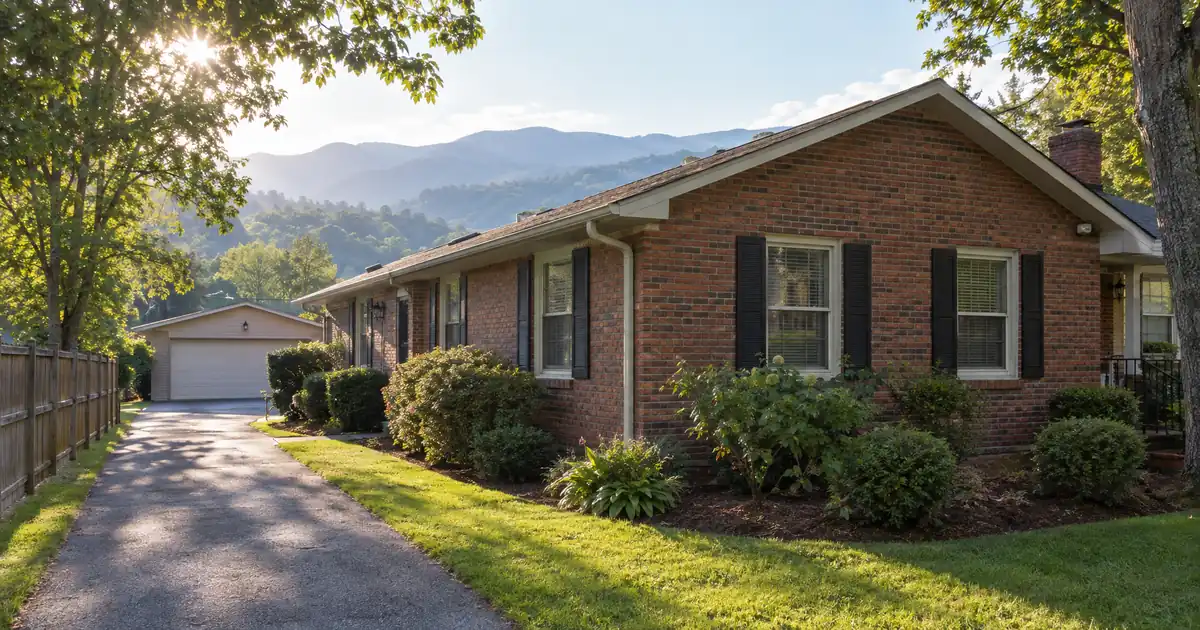
An out-of-state investor scrolling Elizabethton listings sees a median sale price near $260K and a double-digit jump in the headline number. Redfin puts the three-month median at $260K, up 14.4 percent year over year. The investor starts pencilling a big cash-out. The questions that matter come later: what the appraiser will actually support, and whether the rent covers the full obligation on the new, larger balance.
Lendmire (NMLS# 2371349) is a DSCR-focused mortgage broker. For real estate investors in Elizabethton, Tennessee, Lendmire helps structure and place DSCR financing through wholesale lenders operating in 41 markets, including D.C. This article covers the equity-extraction side only: pulling capital out of a rental you already own in a small river town in the Johnson City metro.
DSCR Cash-Out Calculator
Run the cash-out numbers in Elizabethton, TN
Rate source: Freddie Mac 30-yr average via FRED® — Federal Reserve Bank of St. Louis · effective Sep 24, 2026
Prefilled with starting assumptions — enter your property’s value, balance, taxes, and insurance for a more accurate picture.
Program parameters update from Lendmire’s centralized guideline source. Taxes and insurance are editable estimates.
As of Sep 24, 2026 · General Freddie Mac market benchmark, not a Lendmire loan offer. Property value, balance, taxes, and insurance are editable estimates. Maximum loan-to-value varies by lender, program, property type, and seasoning. Not a Loan Estimate, approval, or commitment to lend. Program availability and eligibility are subject to lender guidelines, credit approval, property review, and underwriting.
The Quick Read: A cash-out refinance on an Elizabethton, Tennessee investment property is a DSCR loan underwritten primarily on the property’s rental income measured against its full monthly obligation, with proceeds limited by a 75 percent LTV ceiling and about six months of ownership seasoning, subject to lender guidelines.
- Median sale price sits near $260K per Redfin, but price per square foot fell 16.0 percent.
- Single-family rent-to-price runs roughly 0.6 to 0.7 percent monthly, which makes coverage thin at full leverage.
- Snap-on is Carter County’s third-largest employer.
- Multifamily inventory is nearly absent, so 2-4 unit targets take patience.
Elizabethton Market Snapshot
A quick read on the Elizabethton investor landscape — figures come from the cited sources below. Confirm current property-level numbers before underwriting.
| Metric | Detail |
|---|---|
| Home prices | 61 sales (Redfin Elizabethton Housing) |
| Typical rents | $31,433 renter income (Point2Homes Demographics) |
| Recent appreciation | +14.4% yoy (Redfin Elizabethton Housing) |
| University enrollment | 2,500+ students (City of Elizabethton) |
| Employment | 5.91K employees (Data USA Elizabethton) |
The Headline Number Is Lying to You
Treat the 14.4 percent gain as a sales-mix artifact, not a market-wide appreciation rate. The same Redfin page shows price per square foot at $168, down 16.0 percent. Days on market stretched to 47 from 43 a year earlier, and only 61 homes sold in the most recent month. Thin volume lets a handful of larger or newer sales move the median.
The ZIP-level view is more sober. PropertyIQ, drawing on Zillow-style data for ZIP 37643, shows home values up 3.4 percent over twelve months, with about 23 percent of active listings carrying a price cut. That looks like low single-digit appreciation, not a double-digit boom.
For a cash-out, this matters more than anywhere else in the file. Proceeds are sized off appraised value, and shallow comps make appraisals conservative. An investor who bought a few years back and expects the headline gain to flow through will probably be disappointed. Underwrite to a modest value, and treat anything above that as upside.
Coverage Math at 75 Percent
Single-family rental coverage is the weak point in this market. Sample asking rents for three-bedroom houses run roughly $1,500 to $1,900 a month, per Zillow listings. Against a $260K median, that is a gross rent-to-price ratio of about 0.6 to 0.7 percent monthly. Those are asking rents, not achieved rents, and the ratio is Lendmire Research’s own arithmetic.
Run the numbers on a modeled $260K house at the 75 percent LTV cap. The DSCR is monthly rent divided by the full monthly obligation: principal, interest, taxes, and insurance. Assume a rent of $1,700. Coverage lands around 1.1x including taxes and insurance. Drop the rent to $1,500 and the number slips to roughly 0.98x, just under the standard 1.00 benchmark. At $1,900 it clears 1.2x. These are modeled inputs, not market comps. The point is the spread: a few hundred dollars of monthly rent decides whether the file works.
Sub-1.00 doesn’t end the conversation, but it changes it. A lender may review lower leverage, an interest-only structure, or a stronger credit and reserves profile, all subject to lender guidelines, credit approval, and property review. Expect tighter terms, not the same pricing. The cash-out refinance walkthrough covers how proceeds get sized.
Rent sources disagree here, which is itself a signal. RentCafe shows an average rent of $1,034, while Apartments.com shows $723. Neither is a single-family benchmark. The lender’s appraisal rent schedule is what counts, so pull your own comps before ordering anything.
Where the Equity Actually Sits
The research supports qualitative profiles here, not neighborhood-level price or rent tables. That is a real limitation, so treat the notes below as demand character, not pricing.
Milligan and Cedar Grove (west side). This is the strongest profile for a refinance. Milligan University has more than 1,300 students, most living on its campus, so don’t underwrite this as student housing. The demand is faculty, staff, and commuters, since the area is a short drive from the Johnson City line. Stock runs small to medium single-family homes plus some apartment complexes. Short commutes and a stable institutional base make for steadier lease renewals.
Downtown and the historic core. Here the draw is the 134-foot covered bridge on the Doe River, the county government offices, and small-business tenants. Courthouse and county workers form a dependable renter pool. No reliable price or rent data turned up, so the appraiser’s comps are the only real evidence.
Watauga Point and Riovista. Older workforce stock, much of it built between 1940 and 1970 and mostly owner-occupied. Some residences in the area are mobile homes. Manufactured homes, single-wide or double-wide, fall outside these DSCR programs, so confirm the structure type before you plan a refinance. Older site-built homes carry capex that eats into net income and can drag appraisals.
East Side along the Doe River. Flood history has limited growth here, and the river runs parallel to US-19E. Flood exposure is a diligence item. Skip it as a first refinance target unless the file is clean.
Sycamore Shoals corridor. This one is hospital-adjacent and outdoor-oriented, near the state historic area, the Watauga River, and the Tweetsie Trail. Hospital staff are the steady renter pool. It is a reasonable secondary target with limited data.
The Lever Is Multifamily (Good Luck Finding It)
Two or three units on one loan beat one house, because coverage improves when several rents share one obligation. Sample apartment asking ranges run $979 to $999 for a one-bedroom and $1,009 to $1,449 for a two-bedroom, per RentCafe. Stack two of those and you outrun a $1,600 house.
The catch is supply. A recent Redfin snapshot showed 14 condos, one townhouse, and zero multifamily units for sale in the city. RentCafe puts the average apartment building at about 34 years old. Older buildings mean capex, which cuts net income and can limit appraisal support. If you already own a duplex or small apartment building here, you are in a position most buyers can’t replicate, and your refinance math is stronger for it.
Lower-priced older stock also tends to show stronger rent-to-value in listings, with rents on the least expensive properties running well above what the broader market would suggest relative to price. The trade-off is that cash-out proceeds depend on appraised value, and appraised value is small in that band. A strong ratio on a small balance can still produce modest proceeds.
Demand Anchors Behind the Rents
Rent holds up in Elizabethton on a short list of anchors, and this is where the long-term tenant case lives.
Snap-on is Carter County’s third-largest employer and announced a $44 million expansion creating 50 jobs, per Expansion Solutions Magazine. TNECD lists Sycamore Shoals Hospital at an estimated 269 employees. Carter County Economic Development names Borla Performance Industries as another top manufacturer and cites direct access to Interstate 26.
The resident base is modest but growing. Data USA shows employment up 3.41 percent in its latest year, to 5.91k employees, with health care and social assistance the top resident sector. The city has roughly 14,374 residents per Census Bureau QuickFacts. Per Point2Homes, about 37.4 percent of households rent, and the renter median household income is $31,433, with rent taking 28.3 percent of it. That ratio limits how far rents can climb. Don’t underwrite aggressive growth.
(The same Point2Homes data shows 11.2 percent of housing units vacant, but that’s all units, not a rental vacancy rate. Don’t mistake one for the other.)
What a Working Deal Desk Sees in Markets Like This
In small-metro markets with thin sales volume, the common friction point is the appraisal, not the borrower. Files tend to stall on weak comps or on a rent schedule that doesn’t match the lease in place. The cleaner files usually arrive with a signed lease, a rent comparison, and a clear seasoning timeline already documented. Investors who skip that prep often find the coverage number moves in the wrong direction once the appraiser’s rent estimate comes back.
Seasoning, Ceilings, and Where the Proceeds Go
The structure is simple. Cash-out refinances on investment property typically cap at 75 percent LTV. Seasoning generally runs about six months of ownership, measured from title recording. The standard DSCR benchmark is 1.00. Credit tiers generally start at a 620 floor, and reserves typically run about six months of PITIA. Loan amounts go up to $3,000,000 on standard programs, with smaller balances routed through select lenders in the network. Available equity depends on rent used for lender review, the full obligation, reserves, and the 75 percent ceiling. It is not a guaranteed cash figure, and details are subject to lender guidelines and change.
Entity-owned rentals can be reviewed too, subject to lender program eligibility, which suits investors holding Elizabethton property in an LLC.
The proceeds question is where this market gets interesting. Elizabethton’s own resale prices don’t offer much cash flow per dollar of capital. If the goal is redeploying proceeds, the stronger play might be a duplex or small multifamily here or elsewhere in the Johnson City metro. Investors chasing appreciation could argue for new-build instead, which tends to mean lower near-term capital expenses but thinner cash flow. It is a genuine toss-up, and the answer depends on whether the portfolio needs coverage or growth.
DSCR vs. conventional financing
There are two common ways to finance an investment property in Elizabethton, TN, and they qualify you differently — here’s how investors weigh them.
Why investors choose it
- Qualifies on the property’s rental income — no personal tax returns, W-2s, or pay stubs needed to document income.
- No personal debt-to-income ceiling to clear, so existing mortgages and obligations don’t cap your borrowing the same way.
- Can be closed in an LLC, keeping the property inside a business entity.
- Built for scaling — not held to the limit on number of financed properties that conventional financing applies.
- Underwriting centers on the deal: generally qualifies when the rent covers the payment, a 1.00x coverage ratio being a common baseline (confirmed in underwriting).
- Designed specifically for investment property, including long-term and, where the program allows, short-term rentals.
Where it’s strong
- Often the lowest ongoing financing cost for a buyer who fully qualifies on personal income — a fit for a first property or a cost-first purchase.
Trade-offs for investors
- Requires full personal income documentation and must fit within a debt-to-income limit — salary, existing debts, and other mortgages all count.
- Typically held in your personal name rather than a business entity.
- Caps how many financed properties you can carry, which can become a ceiling as a portfolio grows.
- Evaluates you as a borrower as much as the property, which usually means more paperwork.
How investors usually choose: a first or single property often optimizes for the lowest financing cost; portfolio builders often optimize for leverage, vesting in an LLC, and scaling past conventional caps. The right answer depends on your goals, the property, and current guidelines — both paths run through select lenders in Lendmire’s wholesale network, with eligibility and terms confirmed in underwriting.
Lendmire’s investment property refinance options show how a rate-and-term differs from a cash-out, and the program-to-program comparison lays out when a conventional file might still win. For state-level context, see DSCR loan options for Tennessee investors. To model a specific file, compare DSCR options or call 828-256-2183.
Frequently Asked Questions
How do you qualify for a DSCR cash-out refinance in Elizabethton, Tennessee?
Qualification centers on the property’s rent against its full obligation, with a 1.00 benchmark on most standard programs. Borrowers also need roughly six months of seasoning, credit at or above a 620 floor, and about six months of PITIA in reserves. With sample single-family rents near the middle of the 0.6 to 0.7 percent ratio, many Elizabethton houses will sit close to that line, and exact eligibility depends on lender guidelines.
What are the requirements for an investment property loan in Elizabethton, Tennessee?
The core requirements are an eligible property type, the minimum credit score, reserves, and documented rent. Site-built single-family homes, duplexes, and small multifamily generally fit. Manufactured homes, log homes, and barndominiums fall outside these programs, which matters in older workforce neighborhoods where mobile homes are common.
How much can an Elizabethton investor pull out?
The ceiling is 75 percent of appraised value, minus the existing balance and subject to coverage and reserves. Because the sales volume is thin, appraisals lean conservative. Plan proceeds on a value closer to the low-single-digit ZIP trend than the 14.4 percent headline.
Does Snap-on’s expansion actually move rents?
Not much on its own. A $44 million expansion adding 50 jobs supports tenant demand and retention, and the county’s third-largest employer is a stable anchor. But 50 jobs in a city of roughly 14,000 won’t reshape rents, and the renter income data points to a ceiling.
Can an LLC-owned Elizabethton rental be reviewed for DSCR financing?
Yes, subject to lender program eligibility. Lendmire arranges DSCR investor loans, and the programs underwrite primarily on the property’s rental income rather than personal income documentation. Entity-held rentals are a common fit.
Two Ways to Play It
The Elizabethton owner has a real choice. One option is to refinance now at a conservative appraisal, accept thinner coverage, and move the proceeds into a multifamily property that lifts the portfolio’s overall coverage, with the risk that the right building takes a long time to find. The other is to hold, let the sparse sales volume and the 47-day marketing times settle into a clearer price trend, and refinance later on firmer comps, at the cost of letting capital sit idle in a town where the next 2-4 unit listing may not appear for months.
About Lendmire
A non-QM mortgage broker (NMLS# 2371349), Lendmire arranges DSCR financing for real estate investors in 41 markets, 40 states plus Washington, D.C. Because deals are underwritten primarily on property cash flow rather than personal income documentation, the structure suits self-employed buyers and entity-owned portfolios. Lendmire places loans through wholesale investor lenders and is not a direct lender. It has been recognized as a 2026 Scotsman Guide Top Mortgage Workplace and a 2025 Scotsman Guide Top Mortgage Workplace, and the full Lendmire news archive is available online.
Get Started
Ready to find the right loan for you?
In about 30 seconds you can review financing options available for your investment property. No commitment required.
Informational only. Not a Loan Estimate, approval, or commitment to lend. Program availability and eligibility are subject to lender guidelines, credit approval, property review, and underwriting.
References
1. Redfin
2. Carter County’s third-largest employer
3. Point2Homes
5. Data USA
6. PropertyIQ
8. RentCafe
10. RentCafe
11. Expansion Solutions Magazine
12. TNECD
13. Carter County Economic Development
15. a 2026 Scotsman Guide Top Mortgage Workplace
16. a 2025 Scotsman Guide Top Mortgage Workplace
This article is part of Lendmire’s investment property cash-out refinance program — full qualification details, guidelines, and scenarios live on the program page.
Related reading: DSCR Cash Out Refinance in Elizabethton, Tennessee: Will My Rent Cover the Loan After Cash Out? · DSCR Cash Out Refinance in Johnson City, Tennessee: Pulling Equity From the ETSU Rental Belt · Cash Out Refinance Investment Property in Sparta, Tennessee: What Qualifying Takes on Sparta Rents
Guides: Investment Property Cash-Out Refinance in Tennessee
Brandon Miller
Founder & CEO, Mortgage Loan Originator, Lendmire LLC
- Mortgage Loan Originator · NMLS# 1129696 · Verify on NMLS Consumer Access
- North Carolina Real Estate Broker · License# 343312 · Verify on NCREC
- North Carolina Insurance Producer · License# 19053198 · Property, Casualty, Life, Health · Verify on NAIC SBS
- Lendmire LLC · Firm NMLS# 2371349 · Verify firm licensure
Disclosures. The information presented in this article is general market commentary, not financial, legal, or tax advice. Lendmire is a mortgage brokerage (NMLS# 2371349) — not a direct lender or depository institution — and loan placement is subject to lender underwriting. Nothing in this content represents a commitment to lend. Loan terms, pricing, and program availability vary based on borrower qualifications, property characteristics, and state of subject property, and are subject to change at any time. Lendmire complies with Equal Housing Opportunity requirements. Consumer access: nmlsconsumeraccess.org.