
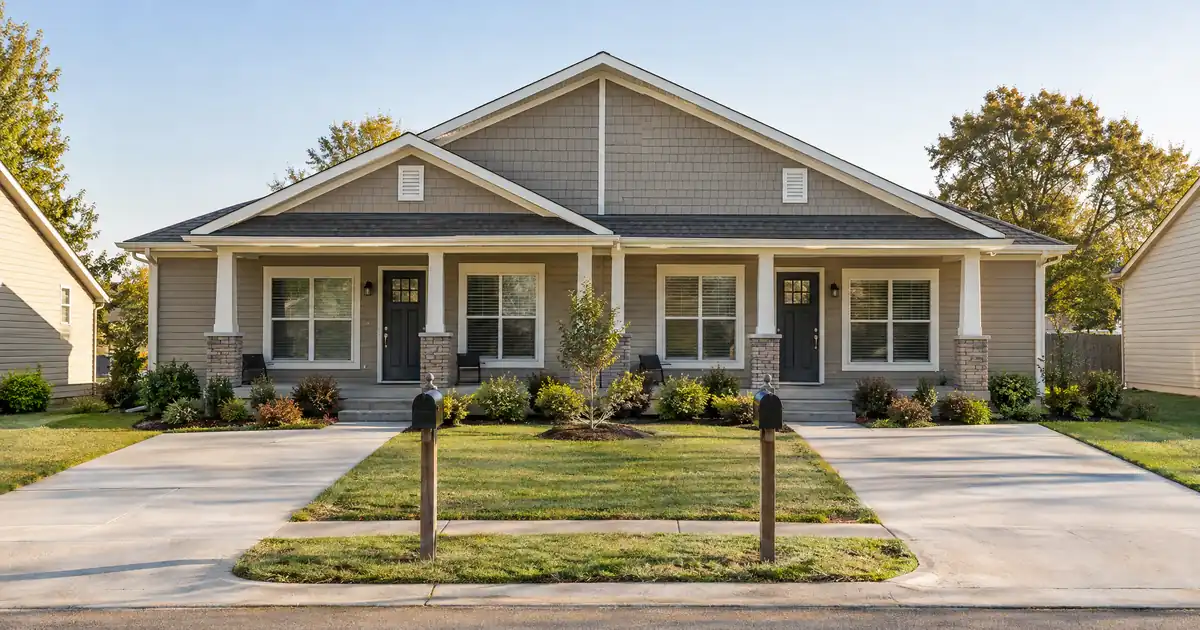
The Quick Read: A DSCR loan can take out ten finished duplexes while they lease up, but it does not pay for the build. The loan is a takeout that replaces cash, construction debt, or a bridge once each building is complete and rentable. Qualification runs primarily on rental income covering the payment, subject to lender guidelines.
- DSCR is takeout money. Something else funds construction.
- Duplexes are 2-unit residential properties, so they fit the product. Ten of them is a structuring question, not an eligibility problem.
- On a vacant building, the appraiser’s market rent usually carries the coverage number.
- The real choice is ten separate loans or one pooled loan.
- The main failure mode is the construction loan maturing before the takeout is in place.
Ten duplexes is twenty units. It is also a big pile of construction exposure. The financing choice decides how much capital comes back for the next phase, and how much risk sits on one note. This piece walks through the sequence, how rent is counted before tenants arrive, how to choose a structure, and where files break. For the full product background, see Lendmire’s complete DSCR loans guide.
DSCR Calculator
Run the numbers in your market
Rate source: Freddie Mac 30-yr average via FRED® — Federal Reserve Bank of St. Louis · effective Oct 29, 2026
Prefilled with starting assumptions — enter your own rent or nightly figures, taxes, insurance, and HOA for a more accurate picture.
Program parameters update from Lendmire’s centralized guideline source. Taxes and insurance are editable estimates.
As of Oct 29, 2026 · General Freddie Mac market benchmark, not a Lendmire loan offer. Rent, nightly rate, occupancy, taxes, and insurance are editable estimates. Short-term rental figures are estimates only and vary significantly by season, property type, management approach, and local short-term-rental rules — confirm local regulations before relying on them. Qualifying income for short-term rentals varies by program — some use appraisal market rent, others use documented STR history or projections — and is confirmed in underwriting. Not a Loan Estimate, approval, or commitment to lend. Program availability and eligibility are subject to lender guidelines, credit approval, property review, and underwriting.
What Is the Two-Loan Sequence?
The sequence is build money first, then a DSCR takeout. Cash, a construction loan, or a bridge loan pays for the build. When a building is finished and rentable, a DSCR loan replaces that short-term debt with long-term rental financing.
Practitioner commentary on a build-to-rent lender thread describes the same order: land bought separately, a construction loan covering the build, then a permanent loan once units are occupied. That is one program’s path, not a market rule. Across the wholesale network Lendmire works with, the pattern is consistent in one respect: DSCR lenders want a finished, rentable property. They do not lend against a slab and a set of plans.
Two gates matter at completion:
- A certificate of occupancy (CO) for each building.
- A property that is lease-ready, meaning it can be shown and rented as is.
If either is missing, the takeout waits. Plan the exit before the first foundation is poured, not when framing wraps.
Key Terms Defined
DSCR (debt service coverage ratio): Monthly rent divided by the full monthly housing obligation on the property.
PITIA: Principal, interest, taxes, insurance, and any association dues, the denominator in the ratio.
Takeout: A long-term loan that pays off short-term construction or bridge debt.
Lease-up: The period between completion and a building reaching full occupancy.
Blanket loan: One note secured by several properties at once.
Cross-collateralization: Pledging every property in a pool as security for the whole loan.
Market rent: The rent an appraiser opines a property would command, shown on a rent schedule.
Do Duplexes Qualify, and Does the Count Matter?
Yes, duplexes qualify. A duplex is a 2-unit residential property, and DSCR programs treat 2-4 unit properties as residential investment property. The property must be non-owner-occupied. DSCR loans are designed for investment properties, and because they are business-purpose loans, they are reviewed differently from a standard owner-occupied mortgage.
Multi-unit buildings tend to help coverage. Two rents sit against one payment, and a single vacancy does not take the building to zero income. That is the main reason duplexes can post stronger ratios than a single-family house at a similar price.
Owning other DSCR loans does not by itself block the next file. Each property is reviewed on its own rent and payment, though reserves and the borrower’s overall exposure still get looked at. Ten buildings does not break eligibility. It changes how much documentation, appraisal work, and reserve money the whole project needs.
Not every structure is eligible. Manufactured homes, log homes, and barndominiums fall outside these programs. Stick-built duplexes are the normal fit.
How Does DSCR Get Calculated on a New, Unleased Duplex?
Coverage is rent divided by PITIA. On a vacant new duplex, the rent figure comes from the appraisal, not from the borrower’s projection. A ratio of 1.00 means rent equals the full payment. Above that, rent exceeds it. Below it, rent falls short.
On 1-4 unit loans, lenders use PITIA in the denominator. Commercial lenders net out taxes and insurance and use a different measure, as one investor-education discussion points out. That is why commercial benchmarks like 1.25x do not transfer to duplex files.
Many select programs start at 1.00. A separate select-lender path takes coverage below 1.00 with leverage and terms adjusted. Stronger ratios generally open better pricing and leverage. Treat 1.00 as where many select programs begin, not as a promise.
One caution on reading the result. Clearing 1.00 does not mean positive cash flow. DSCR compares rent to PITIA only. Repairs, vacancy, management, utilities, and capex sit outside the calculation. A new building has fewer repairs early, but lease-up vacancy is real and has to be funded from somewhere else.
Which Appraisal Form Applies?
Duplexes are appraised on Form 1025, the small residential income property report for 2-4 unit properties. Form 1007 is the comparable rent schedule for one-unit properties. These are cited only for form names. Agency selling-guide rules do not govern DSCR loans. A HUD mortgagee letter also references Form 1025 for small income properties, again as naming context.
What Counts as Leased Enough?
It depends on the program. Some lenders accept a vacant, finished building on market rent alone. Others want a signed lease and deposit. A few ask for a stretch of occupancy before the takeout opens. One build-to-rent lender described a permanent takeout that opened after ninety days of occupancy, which is that one program’s rule and not a standard. Confirm treatment in writing before you plan around it.
| Building status | Rent used | Typical documents |
|---|---|---|
| Built, vacant | Appraiser’s market rent | CO, appraisal with rent schedule |
| Partly leased | Mix of lease and market rent | Above plus signed leases, deposits |
| Fully leased | Lease, tested against market | Leases, deposits, rent roll |
The common convention is that a lease above market rent earns nothing extra, and a discounted lease signed just to fill a unit can pull coverage down. Treat that as a working assumption to confirm with the specific program. The practical point for lease-up: do not sign a cheap lease on day one just to say the unit is leased. Rent concessions can hurt the file more than a vacant unit tested at market.
Ten Loans or One Pool?
Ten separate loans isolate risk. One blanket loan simplifies paperwork. The tradeoff is risk isolation against convenience, and neither is automatically better.
| Factor | Ten separate loans | One blanket loan |
|---|---|---|
| Coverage test | Each duplex alone | Pooled rent vs pooled payment |
| Weak building | Stands or falls alone | Stronger buildings offset it |
| Closings and appraisals | Ten of each | Fewer closings, still every property appraised |
| Default exposure | Contained | Can reach every property |
| Selling one building | Straightforward | Needs a release provision |
Most DSCR loans are one note per property. A blanket is a separate collateral structure, and its availability, size limits, and release terms vary by lender. Pooling lets strong buildings carry weak ones, but it ties every property to one note. A late-completing building that is still in lease-up can drag the pooled number down.
Separate loans cost more in time and closing work. They also let you take out buildings as each reaches completion, and sell or refinance one without disturbing the rest. For a build-and-hold project, that flexibility is often worth the extra paperwork.
Thinking it through: if the buildings finish in waves, per-property loans usually fit better. If all ten finish near the same time and the plan is to hold the full set for years, a pool can be tidier. The honest answer depends on completion timing, entity setup, and what the exit looks like for any single building.
What Does a Mixed-Status Pool Look Like?
Picture a group where six duplexes are leased and four are finished but vacant. Leased buildings are tested at the lower of lease and market rent. Vacant buildings are tested at market rent alone. Then the lender adds up pooled rent and compares it with pooled PITIA.
Say the leased buildings cover at roughly 1.25x and the vacant ones come in near 1.05x on appraiser rent. The pool lands between the two, comfortably above 1.00 in this illustration. But if one appraiser’s rent opinion comes in short on the vacant group, the pool drops fast. There is no lease to offset a low opinion. This is an illustration of the weighting, not a quote or a promise of any result.
Per-building testing shows the same facts more bluntly. The four vacant buildings each stand on their own number. A weak one may need lower leverage, or it may need to wait until a lease is in place.
DSCR vs. conventional financing
There are two common ways to finance an investment property, and they qualify you differently — here’s how investors weigh them.
Why investors choose it
- Qualifies on the property’s rental income — no personal tax returns, W-2s, or pay stubs needed to document income.
- No personal debt-to-income ceiling to clear, so existing mortgages and obligations don’t cap your borrowing the same way.
- Can be closed in an LLC, keeping the property inside a business entity.
- Built for scaling — not held to the limit on number of financed properties that conventional financing applies.
- Underwriting centers on the deal: generally qualifies when the rent covers the payment, a 1.00x coverage ratio being a common baseline (confirmed in underwriting).
- Designed specifically for investment property, including long-term and, where the program allows, short-term rentals.
Where it’s strong
- Often the lowest ongoing financing cost for a buyer who fully qualifies on personal income — a fit for a first property or a cost-first purchase.
Trade-offs for investors
- Requires full personal income documentation and must fit within a debt-to-income limit — salary, existing debts, and other mortgages all count.
- Typically held in your personal name rather than a business entity.
- Caps how many financed properties you can carry, which can become a ceiling as a portfolio grows.
- Evaluates you as a borrower as much as the property, which usually means more paperwork.
How investors usually choose: a first or single property often optimizes for the lowest financing cost; portfolio builders often optimize for leverage, vesting in an LLC, and scaling past conventional caps. The right answer depends on your goals, the property, and current guidelines — both paths run through select lenders in Lendmire’s wholesale network, with eligibility and terms confirmed in underwriting.
How Do You Phase the Takeout Across Ten Completions?
Stagger it by building. Start the takeout conversation during construction, order the appraisal when a building nears its CO, and submit once the building is rentable. Don’t apply on a building that is not finished.
A workable sequence for a phased build:
1. Confirm the entity and title structure before closing on the land.
2. Pre-talk the takeout with a broker while construction is underway, so program rules on vacancy and occupancy are known early.
3. As each building reaches CO, order the appraisal with the rent schedule.
4. Submit the file with the CO, rent evidence, entity documents, and reserve documentation.
5. Pay off that building’s share of the construction or bridge debt at takeout.
Budget the lease-up carry. Interest on the construction or bridge debt keeps running on buildings that are finished but not yet taken out. Lease-up carry is the quiet number that eats projects.
What If the Construction Loan Matures First?
This is a common failure mode for build-and-hold plans. The construction loan runs out before lease-up finishes, and the takeout is not yet available. Practitioner commentary puts construction terms at roughly one to two years, though that is one lender’s comment, not a survey.
Options exist, and they cost money. An extension from the construction lender buys time. A bridge loan can refinance the construction debt until the DSCR takeout opens. Either adds cost and another set of documents. The cleaner fix is to avoid the collision: stagger takeouts as buildings complete, pick a program that closes on market rent without an occupancy waiting period, and keep a contingency written down before the maturity date approaches.
For the lender side of the process, see how a DSCR lender handles lease-up on ten new duplexes. For the exit sequence itself, see Lendmire’s article Can Ten New Duplexes Go From Construction Loan to One DSCR Loan?.
Requalification is the other risk. Credit scores, reserves, and entity documents get reviewed at takeout, not at the start of the build. A score that slipped during construction can change leverage tiers.
What Are the Typical Program Numbers?
These are typical ranges from select lenders in Lendmire’s wholesale network, subject to lender guidelines and not a commitment to lend.
- Purchase leverage: most files land at 75%-80% LTV on an investment property purchase.
- Rate-and-term refinance: a ceiling of 85% LTV applies on select programs for rate-and-term refinances.
- Cash-out refinance: tops out at 75% LTV on standard rentals; about 6 months of seasoning is the common expectation.
- Credit: a 620 floor exists in parts of the network; most programs want around 660; 700 and up unlocks the strongest leverage.
- Loan size: up to $3,000,000 on standard programs, with smaller balances routed through select lenders.
- Reserves: commonly about 6 months of PITIA, stepping up to about 9 months above $1,500,000.
A larger down payment lowers the payment and can lift the coverage number. It does not erase leverage caps, credit floors, reserve rules, or property eligibility. The strongest files clear both tests: enough equity and enough rental coverage. Short-term rental programs have their own rules, and local short-term rental rules can vary by city, county, HOA, and property type, so investors should confirm local rules before relying on projected rental income.
What Documents Does a Ten-Building File Need?
Per building: the CO, the appraisal with rent schedule, and leases and deposits where units are leased. Per pool or per borrower: entity documents, operating agreement, proof of reserves, and insurance for each property.
Entity paperwork trips more files than the coverage math. DSCR loans to LLCs are subject to lender program eligibility. They are generally full recourse to the members through a personal guarantee. Get the operating agreement, good standing certificate, and signer authority lined up before the first takeout, not building seven.
Reserve documentation also scales. Reserves are counted per loan or across the pool, depending on the structure, and a ten-building project can make that a large figure. Show the funds seasoned and in the right account.
When Is DSCR the Wrong Tool?
DSCR is wrong when you need construction money, because it does not fund the build. It is also a poor fit if the buildings will sit empty for a long stretch and the plan depends on early cash flow. In that case, a longer-term construction or bridge arrangement may serve the project better.
Some borrowers consider a single loan that converts from construction to permanent. That is a different product from a two-loan sequence. It can reduce closing steps, though it ties you to one lender and one set of terms. The two-loan path keeps the takeout shop-able.
Common Mistakes
- Applying before the building has a CO.
- Signing a below-market lease to hit a leased-unit count.
- Assuming a coverage number above 1.00 means the project pays for itself.
- Closing land in the wrong entity.
- Letting the construction loan run to maturity with no contingency.
- Assuming program rules on vacancy and occupancy are the same everywhere.
Frequently Asked Questions
Can a DSCR loan fund the construction of the duplexes?
No. It takes out construction debt on a finished property. Cash, a construction loan, or a bridge loan covers the build, and the DSCR loan replaces that debt when each building is rentable.
Do I need a signed lease on a brand-new duplex?
Not always. Many programs rely on the appraiser’s market rent for a vacant building, while others want a signed lease and deposit. Confirm how the specific program treats vacant units before you commit to a plan.
Is there a limit on how many properties I can finance?
Eligibility is reviewed property by property, so owning several DSCR loans does not automatically block another. Reserves and total exposure still get reviewed, and ten buildings means more documentation and reserve funds.
Can a strong building offset a weak one?
Only in a pooled structure, where rent and payment are tested together. With separate loans, each duplex stands on its own number.
What happens if the appraiser’s rent comes in low?
The ratio drops, and on a vacant building there is no lease to offset it. The usual responses are lower leverage, a stronger rent comp package, or waiting for a lease. It is worth requesting reconsideration with documented comps where the opinion looks light.
About Lendmire
Lendmire (NMLS# 2371349), a non-QM mortgage broker serving investors in 41 markets including Washington, D.C., helps structure DSCR scenarios commonly evaluated around a property’s rental income rather than personal income paperwork, subject to lender guidelines. A Scotsman Guide Top Mortgage Workplace in 2025 and 2026, Lendmire places loans through wholesale investor lenders and is not a direct lender.
Get Started
Ready to find the right loan for you?
See your offer in seconds. No credit pull, no obligation.
Informational only. Not a Loan Estimate, approval, or commitment to lend. Program availability and eligibility are subject to lender guidelines, credit approval, property review, and underwriting.
References
1. Fannie Mae Selling Guide B4-1.2-01
2. HUD Mortgagee Letter 2023-17
This article is part of Lendmire’s DSCR loan program — full qualification details, guidelines, and scenarios live on the program page.
Related reading: How to Get a DSCR Loan on a Stonington Rental Property · Can a Logan Ohio Rental Get a DSCR Loan Without a Lease? · How to Get a Condo Through the Questionnaire for a DSCR Loan
Brandon Miller
Founder & CEO, Mortgage Loan Originator, Lendmire LLC
- Mortgage Loan Originator · NMLS# 1129696 · Verify on NMLS Consumer Access
- North Carolina Real Estate Broker · License# 343312 · Verify on NCREC
- North Carolina Insurance Producer · License# 19053198 · Property, Casualty, Life, Health · Verify on NAIC SBS
- Lendmire LLC · Firm NMLS# 2371349 · Verify firm licensure
Required disclosures. Lendmire (NMLS# 2371349) operates as a licensed mortgage broker, not a direct lender or depository. The discussion in this article is general in nature and should not be relied upon as financial, legal, or tax advice — every investment scenario is unique and should be reviewed by a qualified professional. Any loan inquiry is subject to lender underwriting, and this article is not a commitment to lend or a guarantee of approval. Mortgage rates, loan terms, and program guidelines vary by borrower, property, and state, and may change without notice. Equal Housing Opportunity. Verify licensure at NMLS Consumer Access.