
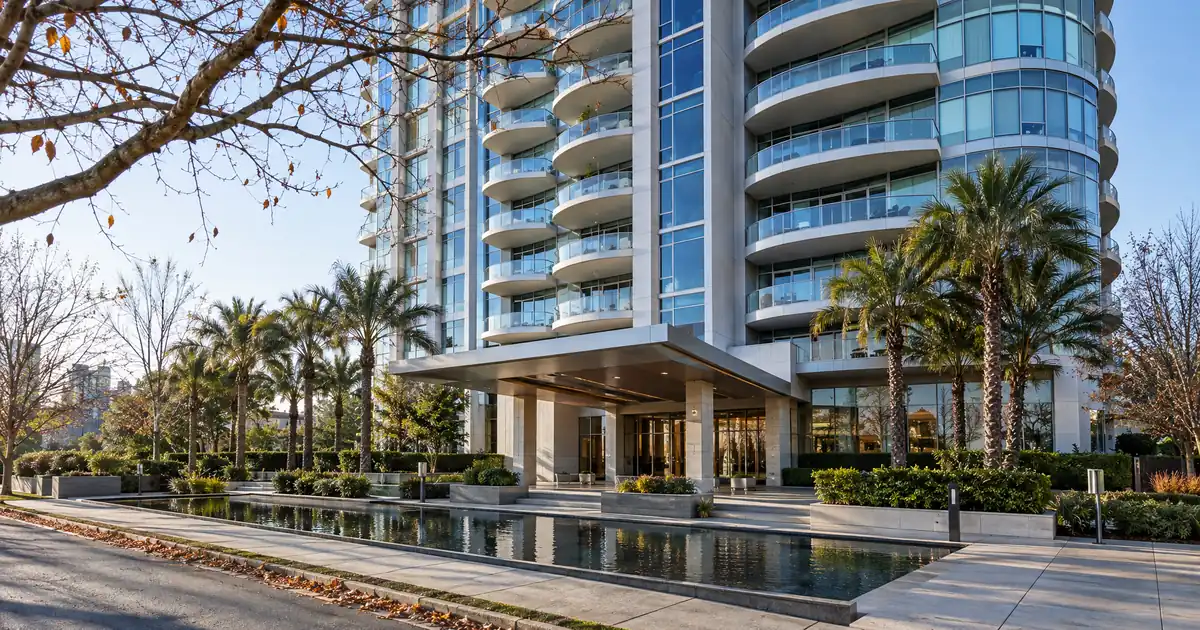
The Quick Read: A super jumbo condotel is financed through portfolio and non-QM programs that test the building’s hotel operations, the loan size and your stated use separately, so the file is built either as a personal-use second home or as a business-purpose rental, depending on who controls the unit. Through select wholesale programs, subject to full underwriting, the main points are:
- Condotels carry their own leverage ceiling: 75% on a purchase and 65% on a cash-out, with 50% on the bank program’s cash-out.
- Loan size sets a second, separate ceiling. Whichever is lower controls.
- Second homes are one-unit only. A condotel with a mandatory rental pool usually fits the pure-rental track better.
- Qualifying income comes from bank-statement deposits, assets, or property cash flow instead of traditional personal-income documentation.
- Every loan above $4,000,000 is reviewed case by case before submission.
What Is a Condotel, and How Does a Lender Tell?
A condotel is a condominium unit inside a building that runs like a hotel. You own the unit. An operator often runs the front desk, the housekeeping and the booking system. The label on the marketing brochure does not decide anything. Control does.
Lenders in the wholesale network ask one question first: who controls occupancy of the unit? If you can list it, rent it, block it for personal use and hire your own manager, the file is usually workable. If an operator sets the calendar, collects the revenue and limits your stays, the file gets much harder. Resale after a foreclosure is narrow in that case, and lenders price that risk or decline.
The red flags are practical ones. Think daily housekeeping, a central key system, a concierge desk, very small units, no full kitchen, and marketing built around nightly rates. A building with a hotel next door is not a condotel. A building with a mandatory rental program is.
Two more points matter. A condotel is a subset of non-warrantable condos, so the file inherits those questions too: investor concentration, litigation, HOA financial health. And mislabeling happens. A clean condo that lists on booking sites can get flagged as a condotel, so the building documents matter more than the reputation.
Why Condotels Sit Outside Standard Bank Financing
Standard agency-backed channels exclude them. Fannie Mae’s Selling Guide on ineligible projects lists projects managed and operated as a hotel or motel, even when the units are individually owned, and it also excludes timeshare and fractional ownership projects. The agency’s own project-review tooling carries a condotel or resort type project reason code for the same issue.
That is the whole agency story for this article. There is no such thing as an agency-approved condotel, so the loan moves to portfolio and non-QM programs. Those programs write their own building rules. The wholesale network the brokerage works with reviews condotels building by building, and the answer on one tower does not carry to the next.
What Does “Super Jumbo” Add?
Jumbo means a loan above the conforming limit. Super jumbo is where the tighter overlays begin. Across the network, two wholesale programs cover the range from $300,000 to $30,000,000. A portfolio non-QM bank-statement program carries files to $6,000,000. Exact terms depend on lender and investor guidelines, credit profile, reserves, and property review.
Size matters because leverage steps down as the balance rises. Through select wholesale programs, subject to full underwriting, here is how it reads on a second home purchase:
| Loan size | Max LTV, second home purchase | Program |
|---|---|---|
| $1M–$1.5M | 80% | Portfolio |
| $1.5M–$2M | 80% | Portfolio |
| $2M–$2.5M | 80% | Portfolio |
| $2.5M–$3M | 75% | Portfolio |
| $3M–$4M | 65% | Portfolio, super-jumbo overlays |
| $4M–$5M | 65%, on review | Portfolio, super-jumbo overlays |
The top cell in each band needs a credit score of 680 at $1M–$1.5M, 700 at $1.5M–$2M, 720 from $2M to $3M, and 760 from $3M to $5M. A lower score takes a lower cell inside the same band. Above $4,000,000, every second-home figure is reviewed case by case before submission. Nothing at that size is a flat promise. These specifics are subject to lender guidelines and a full review of property, leverage, and credit.
Now the condotel layer. The condotel purchase ceiling is 75%. So on a loan between $1,000,000 and $2,500,000 the building cap sits below the size ladder, and the lower number controls. At $2.5 million to $3 million, the 75% condotel cap and the 75% second-home size cap line up. Above $3,000,000, the size ladder is the binding constraint, not the building. That is the answer to the question most buyers have: at super jumbo size, loan size tends to bind before property type does.
A primary-residence ladder is more generous, but a condotel is almost never a primary residence, so skip those figures. Second homes and investment property have their own ladders, so read each from its own table rather than subtracting from another.
The overlays also change above the super-jumbo line. On a second home or investment property above $3,000,000, expect a 700 credit floor, a 0x30x24 housing history, 48-month seasoning on any credit event, and U.S. citizen or permanent resident status. No non-occupant co-borrowers. No rural property. And cash-out proceeds cannot satisfy reserves.
Second Home or Pure Rental: The Occupancy Fork
Occupancy is stated intent, and it is underwritten as stated. It decides the documentation, the leverage ladder and which building features are tolerable.
| Factor | Second home | Pure rental (investment) |
|---|---|---|
| Your use | Part of the year, exclusive control | None, or minimal |
| Property type | One unit only | One unit or more |
| Qualifying basis | Your documented income or assets | Your bank statements or property rent |
| Mandatory rental pool | Poor fit | Often the natural fit |
| Loan character | Consumer purpose | Business purpose |
A second home needs you to actually use the place, and it needs you to control it. A unit locked into an operator’s pool fails that test. A second home that is operated as a rental from day one is a misclassification risk. It can lead to repricing or denial. Do not label a pure rental as a second home to get better terms.
There is also a regulatory line. Under Regulation Z’s business-purpose rule, credit to acquire or maintain non-owner-occupied rental property is treated as business purpose. But if the owner expects to occupy the property more than 14 days in the coming year, that treatment does not apply. So personal-use weeks are not a harmless footnote. They can move the file from the business-purpose track to the consumer track.
Practically, that means a hybrid buyer has to pick. Most of the network’s investor-track files assume little or no personal use. If you want real owner weeks, the second-home track is the honest fit, but then the building cannot force you into a pool. Lendmire’s piece Does Occasional Rental Use Void a Super Jumbo Second-Home Loan? covers the in-between case.
Consumer mortgage lending, which is what a second-home file is, is licensed in 16 states: AL, CA, CO, FL, GA, IN, MI, MT, NM, NC, OH, PA, TN, TX, VA and WA. That footprint matters for second-home files.
How Income Is Documented on Each Path
Founders, physicians, attorneys and investors often show modest taxable income on paper. The programs below qualify on documented deposits, assets or property cash flow, under the applicable program and subject to lender guidelines.
| Path | How it works | Fits best |
|---|---|---|
| Bank statements | 12 or 24 months of deposits, less an expense ratio | Self-employed, high cash flow |
| Asset allowance | Liquid assets divided by 36, 60 or 84 months | Second-home buyers with large liquid balances |
| Assets only | Liquidity equals loan plus closing costs | Second-home buyers holding wealth in cash and securities |
| Property cash flow | Rent against the full monthly obligation | Pure-rental buyers |
On bank statements, business accounts need at least 25% ownership. The fixed ratios vary by business type, with a lower ratio for a service business with no employees and higher ratios for businesses with employees or any product business. An accountant-provided ratio or a profit-and-loss method capped at 80% also exist. Transfers from your own business into a personal account count in full. Statements must be consecutive. A transaction history does not substitute.
The asset paths are for primary and second homes only, so they fit the second-home track and not a pure rental. A pure-rental buyer is reviewed on bank statements or property cash flow instead. The asset allowance uses a 36-month period when the asset income supplements other income and the DTI before the asset income is at or below 60%, a 60-month period when that DTI is above 60%, and an 84-month period when the asset income stands alone or the loan is above $3,500,000. Retirement accounts count at 70%, or 80% at age 59½ and up. Business funds, gifts, cryptocurrency, unvested stock and most trusts do not count.
Pure-rental files can qualify primarily on property-level rental income covering the payment, subject to lender guidelines, but on a condotel that rent is the hard part. Pool fees and operator splits come out of gross revenue first. Lenders look at trailing statements, not the brochure projection. Some lenders in the network accept the rent path on a condotel; many prefer to qualify the borrower on statements and treat rent as support. Programs below 1.00 coverage are available through select lenders in the network, with LTV and terms adjusted.
Credit and reserves are straightforward. The portfolio program starts at a 660 floor and the bank program at 680, with 700 above the super-jumbo line on the portfolio program. DTI runs to 50%. Reserves are 3 months to $500,000, 6 months to $1,500,000 and 9 months above that, plus 2 months for each additional financed property up to a 12-month maximum. First-time investors need 12 months.
The Document Package That Decides the File
Clean documents give a lender fewer preventable gaps to review. For a condotel, the package is heavier than for a plain condo.
1. Condo questionnaire. It covers HOA financials, reserves, litigation, and the share of owners late on dues. Incomplete questionnaires are the most common stall.
2. Master insurance evidence. Request it early. A stale or partial certificate restarts the review.
3. Rental pool or management agreement. Lenders read term, exit rights, fee splits and whether participation is mandatory.
4. Appraisal with rent support. A condo unit normally uses the condo form. Rental support comes from a rent schedule. Short-term rental files often need an income analysis or historical statements.
5. Entity papers, if buying in an LLC. Vesting in an LLC on the investor track is common, with a personal guarantee, subject to program terms.
6. Reserves documentation. Show the liquid funds that stay after closing. Cash-out proceeds cannot count toward reserves at the overlay sizes.
Pull the building documents before you make an offer. If the pool is mandatory and the operator controls the calendar, you will know in the first read.
Where the Rules Break
- Branded residences are not condotels. A luxury residence above a hotel brand is usually non-warrantable because of commercial influence, not because of a rental pool. Leverage caps can differ between the two.
- A voluntary pool can still count against you. Blackout dates and occupancy limits can make an optional program look like hotel control.
- Not every non-warrantable condo is a condotel. Investor concentration, litigation and new construction cause different problems. Warrantable condos run to 85% and non-warrantable to 80% in the network, while condotels sit at 75% on a purchase.
- Cash-out is tighter. Through select wholesale programs, a condotel cash-out runs to 65%, and to 50% on the bank program. On the portfolio program, cash-in-hand is capped at $1,500,000 when LTV is above 60%, and unlimited at or below 60%. The bank program publishes no cap.
- Trust and entity vesting. Revocable living trusts count for assets, but other trusts do not. See Lendmire’s piece How to Finance a Condotel as a Second Home on Asset-Based Income for that path.
The Honest Tradeoffs
The financing is thinner than on a plain condo. Resale often goes to cash buyers or buyers with portfolio loans, which narrows your exit.
The return question needs its own scrutiny. Pool fees, HOA dues and operator splits all come off the top. A unit that looks strong on gross revenue can show thin coverage once the full monthly obligation is counted. At super jumbo size, thinner leverage means more cash in the deal, and that lowers cash-on-cash. Run the full obligation against net rent before you sign, not the other way around.
Short-term rental rules can vary by city, county, HOA, and property type, so investors should confirm local rules before relying on projected rental income. Tax treatment can depend on how the funds are used and how the property is held; investors should keep clear records and speak with a qualified tax professional before relying on any deduction.
Which Track Fits You? A Decision Table
| Your situation | Likely track | What to watch |
|---|---|---|
| Use it several weeks a year, rent little | Second home, statements or assets | Pool must be optional |
| Mixed use, operator controls calendar | Usually pure rental | Personal days change the loan class |
| Pure investment, statement-rich | Investment, bank statements | Overlays above $3,000,000 |
| Pure investment, thin personal income | Investment, property cash flow | Fee-adjusted rent coverage |
One more reasoning point. If the numbers only work at a lower balance, a smaller unit often works better than a larger one: less exit liquidity, but more room under both the building cap and the size ladder. A buyer who treats the size ladder as the first filter will usually save the most time.
Key Terms Defined
Condotel: a condominium unit in a building run like a hotel, often with an operator and a rental program.
Rental pool: an arrangement where unit owners share revenue from nightly rentals managed by an operator.
Non-warrantable condo: a condo project that falls outside standard agency project rules because of investor concentration, litigation, hotel operations or similar issues.
Super jumbo: a loan far above the conforming limit, where leverage steps down and extra overlays apply.
Reserves: liquid funds you hold after closing, counted in months of the full monthly obligation.
Frequently Asked Questions
Can a super jumbo condotel be financed as a second home?
Sometimes. The building must let you use the unit and keep control of it, and the unit must be one dwelling. A mandatory rental pool or operator-controlled calendar usually pushes the file to the pure-rental track. Second-home files are one-unit only through select wholesale programs, subject to full underwriting.
What is the maximum LTV on a condotel?
On a purchase the condotel ceiling is 75%, and on a cash-out it is 65% (50% on the bank program). The loan-size ladder can be lower. On a second home purchase between $3,000,000 and $4,000,000, the size ladder gives 65%, so size controls. Above $4,000,000 it is reviewed case by case before submission.
Do I need a 700 credit score?
At the entry sizes the floor is 660 on the portfolio program and 680 on the bank program. Above the super-jumbo line, which is $3,000,000 on a second home or investment property, the floor is 700. Some size bands call for 720 or 760 on top of that for the top leverage cell. Final terms depend on lender guidelines, property type, leverage, and the borrower’s complete credit picture.
Can I qualify without traditional personal-income documentation?
Yes, under the applicable program and subject to lender guidelines. Twelve or 24 months of bank statements can carry either track. An asset-based path can carry a second-home file, and property cash flow can carry a pure rental. The documents still have to be complete and consecutive.
Can an LLC buy the unit?
On the investor track, vesting in an LLC is commonly allowed with a personal guarantee, subject to program terms. A second home normally closes in your own name. Confirm the entity papers before you contract.
Next Step
Reach the team at 828-256-2183, or read the complete DSCR loans guide for the rental-income path. Programs change, every file is underwritten individually, and nothing here is a commitment to lend.
At super jumbo size, the building review and the loan-size ladder are two separate gates, and buyers who clear both on paper before they bid tend to avoid the repricing that follows a late surprise.
For current guidelines and terms, see Lendmire’s super jumbo bank statement loan programs page.
Lendmire’s self-employed mortgages page presents both super jumbo programs, bank statement and DSCR, side by side.
About Lendmire
Lendmire (NMLS# 2371349) is a mortgage brokerage focused on DSCR investor financing, helping arrange programs through wholesale and investor-lending channels in 41 markets, including Washington, D.C. DSCR loans are evaluated by the lender on property cash flow rather than personal income, subject to lender guidelines, supporting LLC closings and accommodating investors with four or more financed properties. Scotsman Guide Top Mortgage Workplace in both 2025 and 2026.
Get Started
Ready to find the right loan for you?
In about 30 seconds you can review financing options available for your home or investment property. No commitment required.
Informational only. Not a Loan Estimate, approval, or commitment to lend. Program availability and eligibility are subject to lender guidelines, credit approval, property review, and underwriting.
References
1. Fannie Mae Selling Guide, B4-2.1-03 Ineligible Projects
2. Fannie Mae Condo Project Manager status-message reference
This article is part of Lendmire’s super jumbo bank statement loan program — full qualification details, guidelines, and scenarios live on the program page.
Related reading: How a Super Jumbo Mortgage Works for Physicians · How Big Can a Super Jumbo Bank Statement Second-Home Loan Be? · How a Super Jumbo Mortgage Works for Attorneys
Brandon Miller
Founder & CEO, Mortgage Loan Originator, Lendmire LLC
- Mortgage Loan Originator · NMLS# 1129696 · Verify on NMLS Consumer Access
- North Carolina Real Estate Broker · License# 343312 · Verify on NCREC
- North Carolina Insurance Producer · License# 19053198 · Property, Casualty, Life, Health · Verify on NAIC SBS
- Lendmire LLC · Firm NMLS# 2371349 · Verify firm licensure
Required disclosures. Lendmire (NMLS# 2371349) operates as a licensed mortgage broker, not a direct lender or depository. The discussion in this article is general in nature and should not be relied upon as financial, legal, or tax advice — every investment scenario is unique and should be reviewed by a qualified professional. Any loan inquiry is subject to lender underwriting, and this article is not a commitment to lend or a guarantee of approval. Mortgage rates, loan terms, and program guidelines vary by borrower, property, and state, and may change without notice. Equal Housing Opportunity. Verify licensure at NMLS Consumer Access.