
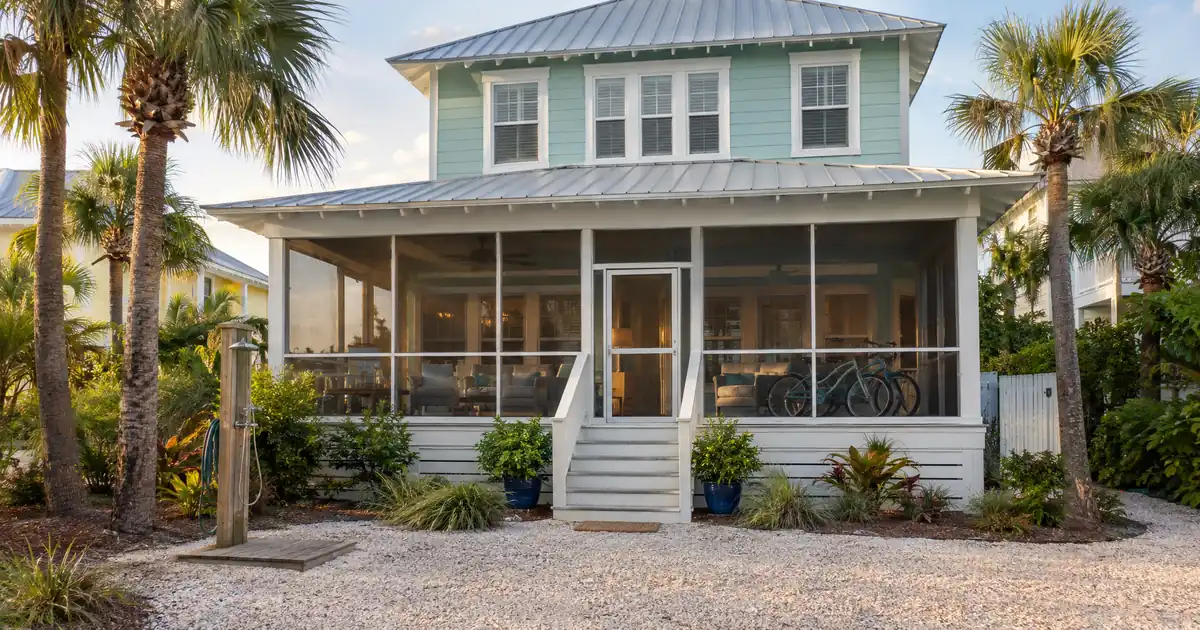
Beach House DSCR Loan Requires For Short-Term Rentals — The Quick Read: A beach house DSCR loan is reviewed on the property’s rental income rather than the borrower’s traditional personal-income documentation, but a nightly-rental beach property gets underwritten differently than a long-term rental. Lenders discount gross short-term rental revenue, usually to 80% of documented income, before it ever enters the coverage-ratio math. Loan size on the short-term rental path tops out lower than the standard program, leverage steps down as the loan gets larger, and flood zone, condo warrantability, and local permitting can all move the numbers independent of how well the property actually rents.
Key Terms Defined
DSCR (Debt Service Coverage Ratio): the property’s monthly rental income divided by its full monthly obligation — principal, interest, taxes, insurance, and HOA dues, where applicable. A ratio of 1.00 means the rent covers the payment exactly.
Short-Term Rental Calculator
Run the STR numbers in your market
Rate source: Freddie Mac 30-yr average via FRED® — Federal Reserve Bank of St. Louis · effective Sep 17, 2026
Prefilled with local estimates — enter your nightly rate, occupancy, taxes, and insurance for a more accurate picture.
Short-term rental income is documented with a 12-month history or a market data report. Program parameters update from Lendmire’s centralized guideline source.
As of Sep 17, 2026 · General Freddie Mac market benchmark, not a Lendmire loan offer. Nightly rate, occupancy, taxes, and insurance are editable estimates. Qualifying income for short-term rentals varies by program — some use appraisal market rent, others use documented STR history or projections — and is confirmed in underwriting. Not a Loan Estimate, approval, or commitment to lend. Program availability and eligibility are subject to lender guidelines, credit approval, property review, and underwriting.
PITIA: shorthand for the full monthly housing obligation used in the DSCR denominator — principal, interest, taxes, insurance, and association dues.
No-ratio loan: a qualification path where the lender does not require a minimum coverage number at all. It trades off against reduced leverage and stronger credit.
Non-warrantable condo: a condo project that fails Fannie Mae or Freddie Mac’s project-level review — often because too many units are investor-owned or rented short-term. DSCR lenders can still finance individual units in these buildings.
V-zone / VE flood designation: an FEMA flood-hazard category for coastal areas exposed to high-velocity wave action, distinct from standard inland flood zones. It carries a mandatory flood insurance requirement for any federally backed mortgage, per the FEMA Flood Insurance Terminology Index.
STR income analysis: a narrative appraisal addendum built specifically for nightly-rental properties, separate from the standard long-term rent schedule appraisers use for leased investment homes.
How the Income Gets Documented on a Beach House
The income side of a beach house DSCR file runs on one of two tracks, and which track applies depends entirely on whether the property already has an operating history.
For a refinance on a beach house already running as an Airbnb or VRBO, the file typically leans on twelve months of platform statements or bank deposit history. Across the wholesale network Lendmire works with, that trailing twelve-month window matters more than almost any other document in the file — a partial year, especially one that only captures peak summer months, tends to get pushed into the slower appraisal-based analysis instead. Lenders want the full seasonal cycle, not the best three months of it.
For a purchase with no operating history, the income comes from an appraiser’s dedicated short-term-rent analysis or from third-party market data tools like AirDNA. Either way, the appraisal is doing two separate jobs in the same report: valuing the property as collateral, and separately opining on what it should earn as a rental. Those are two distinct conclusions, never blended into one number.
Once the gross figure is established — whether from history or projection — it does not go straight into the coverage-ratio math. Programs in Lendmire’s network that offer the short-term rental path typically discount qualifying income to around 80% of documented gross revenue before calculating the ratio. That haircut absorbs vacancy, guest turnover costs, furnishing wear, and the seasonal swing that a beach house sees between July and February.
Why a Standard Rent Schedule Doesn’t Work Here
The tool appraisers use for a leased single-family rental, Form 1007, was built to compare the subject property against annual leases — not nightly bookings. Multiplying a nightly rate by 30 to estimate a monthly figure ignores furnishing costs, guest services, and the operating structure of a nightly-rental business, which is exactly why a separate short-term analysis exists as its own document rather than a modified version of the standard rent form. An appraiser forcing seasonal nightly income into a form meant for year-round leases produces a number that doesn’t reflect how the property actually performs.
That gap is also why documentation matters so much on the purchase side. Without an operating history to lean on, the appraiser’s short-term analysis — or an AirDNA-style market projection — becomes the entire evidentiary basis for the income line. A thin or rushed version of that document is the single most common reason a beach house STR file gets sent back for more information.
Investors weighing a beach purchase against a condo-hotel unit in the same market should read Lendmire’s complete DSCR loans guide for how income documentation compares across property types before assuming both will underwrite the same way.
The Coverage Ratio Math on a Beach House
Coverage of 1.00 or higher on the short-term rental path earns access to full available leverage for the loan size. That’s the benchmark most STR files are built around, though it’s a program threshold rather than a universal rule — qualification still depends on the lender, the property, and the file’s overall strength.
A property that lands between 0.75 and 0.99 on discounted short-term income isn’t automatically dead. That band is a real qualification path through select programs in Lendmire’s network, up to a loan cap of $2,000,000, but leverage and terms adjust downward to compensate for the thinner margin. No-ratio options are also available through select lenders in the network, with leverage and terms set by that specific program rather than by a coverage figure. Investors weighing sub-1.00 territory on a beach house need to size the leverage tradeoff carefully rather than assume the ratio alone decides the outcome.
Run the numbers on a beach cottage where twelve months of platform statements show strong summer performance and a soft winter shoulder season. If the blended, discounted monthly income clears the full obligation with room to spare — comfortably above 1.00x — the file qualifies for stronger leverage. If the same property lands in the high 0.80s once the off-season months are averaged in, it may still move forward through a reduced-leverage structure, but the investor should expect a larger down payment and tighter reserve requirements as the tradeoff. Every figure here varies by lender and program — guidelines, property type, leverage, and credit profile all apply.
Leverage, Credit, and Reserves on the STR Track
Loan size on short-term rental files tops out at $2,000,000 through Lendmire’s wholesale network — a lower ceiling than the standard DSCR program, which runs to $3,000,000 before an oversize ladder carries qualified investors up to $10,000,000 on non-STR collateral. Below $1,000,000, purchase and rate-and-term leverage typically reach 80% with credit at 660 or better. From $1,000,000 to $2,000,000, that steps down to 75% purchase leverage with a 700-plus credit profile expected on most files. Cash-out on short-term rental collateral is scoped lower than on a standard long-term rental in that same size range — 70% for STR-secured cash-out versus 75% for a comparable standard rental cash-out, both subject to underwriting.
Reserves run a baseline of six months of the property’s full obligation, and lenders in the network typically want twelve months from a first-time real estate investor rather than an experienced one. The short-term rental path itself is generally reserved for investors who already own income property — most programs look for at least twelve months of ownership experience within the last thirty-six months before extending the STR income track at all. That experience requirement exists because nightly-income properties carry more month-to-month variability than a leased rental with a fixed check every 30 days, and lenders want to see that the borrower has managed that variability before.
Above $2,000,000, two separate appraisals are typically required rather than one, adding another layer of review to the collateral side of the file. Interest-only structuring is available on many files up to 75% leverage with coverage of 0.75 or better, running up to a 120-month interest-only period on 30- and 40-year terms — a structure some beach house investors use to keep the monthly obligation lighter during the early hold period while the property builds an operating track record.
Across the deals Lendmire’s network sees on coastal properties, the files that move without friction tend to share one habit: the investor pulled a full trailing twelve months of platform statements before applying, not a curated stretch from the busiest quarter. A partial-year file almost always routes into the slower appraisal-analysis path instead, which adds a step most sellers of turnkey beach rentals would rather avoid.
Flood Zones, Coastal Insurance, and Non-Warrantable Condos
Beach properties sit disproportionately in FEMA’s highest-hazard coastal flood zones, and that designation changes the payment side of the DSCR ratio, not the income side. A property mapped in a V or VE zone — FEMA’s designation for coastal areas exposed to high-velocity wave action — carries a mandatory flood insurance requirement on any federally backed mortgage, a rule tied to the National Flood Insurance Program’s statutory framework for communities that participate in the program, per the Congressional Research Service. DSCR loans are business-purpose and not sold to Fannie Mae or Freddie Mac, but the underlying flood-insurance mandate and the FEMA V-zone designation still apply to the property itself, independent of loan type. That insurance cost sits inside PITIA and lowers the ratio if it’s higher than expected — worth pricing before the offer, not after.
Condo buildings at the beach carry their own wrinkle. A high concentration of short-term rentals in a project is one of the classic triggers that makes a condo building fail agency warrantability review, and beach towns are full of exactly that concentration. DSCR lenders generally bypass that review because the loan doesn’t sell to the agencies, and Lendmire’s network can finance individual units in non-warrantable buildings up to 75% leverage and a $1,500,000 loan cap, as long as the specific unit’s income covers its own obligation. That’s a meaningful advantage for investors targeting condo inventory in heavily short-term-rented buildings that a conventional buyer couldn’t touch.
DSCR vs. conventional financing
Two common ways to finance an investment property in this market. They qualify you differently — here’s how investors weigh them.
Why investors choose it
- Qualifies on the property’s rental income — no personal tax returns, W-2s, or pay stubs needed to document income.
- No personal debt-to-income ceiling to clear, so existing mortgages and obligations don’t cap your borrowing the same way.
- Can be closed in an LLC, keeping the property inside a business entity.
- Built for scaling — not held to the limit on number of financed properties that conventional financing applies.
- Underwriting centers on the deal: generally qualifies when the rent covers the payment, a 1.00x coverage ratio being a common baseline (confirmed in underwriting).
- Designed specifically for investment property, including long-term and, where the program allows, short-term rentals.
Where it’s strong
- Often the lowest ongoing financing cost for a buyer who fully qualifies on personal income — a fit for a first property or a cost-first purchase.
Trade-offs for investors
- Requires full personal income documentation and must fit within a debt-to-income limit — salary, existing debts, and other mortgages all count.
- Typically held in your personal name rather than a business entity.
- Caps how many financed properties you can carry, which can become a ceiling as a portfolio grows.
- Evaluates you as a borrower as much as the property, which usually means more paperwork.
How investors usually choose: a first or single property often optimizes for the lowest financing cost; portfolio builders often optimize for leverage, vesting in an LLC, and scaling past conventional caps. The right answer depends on your goals, the property, and current guidelines — both paths run through select lenders in Lendmire’s wholesale network, with eligibility and terms confirmed in underwriting.
On the agency side specifically — relevant mainly as context, since DSCR loans don’t follow it — Fannie Mae recently set a maximum per-occurrence, per-unit deductible limit for master condo insurance policies, requiring a supplemental policy when a coastal association’s wind deductible runs above that threshold, per Fannie Mae Lender Letter LL-2026-03. It’s a conventional-loan rule, not a DSCR one, but it signals how live an issue coastal master-policy deductibles are becoming across the industry — and a high deductible on the association side can still push an individual owner’s supplemental insurance cost up regardless of loan type.
Local Rules: The Variable a Lender Can’t Assume
Whether a beach house can legally operate as a nightly rental at all is decided locally, sometimes down to the specific parcel or HOA — never by the state as a whole. Short-term rental rules can vary by city, county, HOA, and property type, so investors should confirm local rules before relying on projected rental income. A lender’s short-term rental income track generally presumes the use is legal and licensed where required. An investor buying into a market that’s actively capping or phasing out new STR permits is taking on a risk that has nothing to do with the loan and everything to do with whether the income basis for that loan still exists after closing. Confirming municipal and HOA permission for the specific address, before making an offer, is cheaper than finding out after the appraisal comes back.
For a deeper look at how coastal HOA and condo rules interact with income documentation, Lendmire’s article on what a short-term rental DSCR loan treats a beach house as walks through the property-level considerations in more detail.
The Most Common Mistake
The single most repeated error is treating a nightly rate as a simple multiplication problem — take the summer rate, multiply by 30, call it monthly rent. That number ignores the off-season months, the vacancy between bookings, furnishing and guest-service costs, and the seasonal ramp every beach market experiences. It’s why the appraiser’s short-term-rent analysis exists as its own document rather than a shortcut on the standard rent schedule, and why lenders discount gross income before it ever reaches the coverage ratio. Investors who model income using peak-season numbers alone tend to be disappointed by what the file actually qualifies for.
DSCR loans are designed for non-owner-occupied investment properties. Because they are business-purpose investor loans, they are reviewed differently from a standard owner-occupied mortgage — and that distinction is exactly why property-level income, not traditional personal-income documentation, drives the beach house qualification process. For a broader comparison of how that qualification differs from a conventional loan, see Lendmire’s guide on DSCR vs. conventional financing.
Tax treatment can depend on how the funds are used and how the property is held; investors should keep clear records and speak with a qualified tax professional before relying on any deduction.
Frequently Asked Questions
Does a beach house need a full year of Airbnb history to qualify?
Not on a purchase, but it helps significantly on a refinance. Purchases without operating history typically rely on an appraiser’s short-term-rent analysis or third-party market data instead, while refinances lean on twelve months of trailing platform statements. A partial-year history usually gets routed into the slower appraisal-based path rather than accepted as-is.
Can a condo in a heavily short-term-rented building still qualify?
Often, yes. Non-warrantable condos — including buildings with a high concentration of short-term rentals — can qualify through select programs in Lendmire’s wholesale network up to 75% leverage and a $1,500,000 cap, since DSCR loans aren’t sold to the agencies that enforce warrantability review. The specific unit still needs to cover its own obligation.
What happens if the coverage ratio comes in under 1.00?
A sub-1.00 result on discounted short-term rental income isn’t automatically disqualifying. Select programs allow qualification down to a 0.75 coverage band up to $2,000,000, with leverage and terms adjusted to offset the reduced ratio, subject to underwriting. No-ratio qualification is also available through select lenders in the network, with leverage and terms set by that program.
Does flood zone designation affect DSCR loan approval?
It affects the payment side of the ratio more than approval itself. A property in an FEMA V or VE zone carries a mandatory flood insurance requirement, which adds to the monthly obligation and can pull the coverage ratio down if the insurance cost runs higher than budgeted. It’s worth pricing flood coverage before making an offer, not after the appraisal comes back.
Is there a minimum ownership experience required for the short-term rental income path?
Most programs in Lendmire’s network expect at least twelve months of owning income property within the past thirty-six months before extending the short-term rental income track. First-time investors can generally still access DSCR financing, but usually through the standard long-term rental income path rather than the STR-specific one.
If you’re buying or refinancing a beach property and want to see how leverage, coverage, and reserves line up for your specific file, Lendmire can help compare DSCR loan options based on the property’s income, credit profile, and investor goals. Reach the team at 828-256-2183 or request a quote directly.
For current guidelines and terms, see Lendmire’s super jumbo DSCR loan programs page.
Self-employed borrowers can compare both super jumbo programs on Lendmire’s self-employed mortgages page.
About Lendmire
Lendmire — NMLS# 2371349 — is a mortgage brokerage specializing in DSCR investor loans, helping arrange financing across 40 markets, including Washington, D.C., through wholesale and investor-lending channels. The model centers on property-level rental income reviewed by the lender rather than W-2 documentation, subject to lender guidelines, suiting entity-owned and multi-property investors. Lendmire holds Scotsman Guide Top Mortgage Workplace recognition for 2025 and 2026.
Investors focused on short-term rentals can review DSCR loans for Airbnb and short-term rentals.
Lendmire’s Top Mortgage Workplace recognition is documented by Scotsman Guide 2025 Top Mortgage Workplace and Scotsman Guide 2026 Top Mortgage Workplace.
Get Started
Ready to find the right loan for you?
In about 30 seconds you can review financing options available for your home or investment property. No commitment required.
Informational only. Not a Loan Estimate, approval, or commitment to lend. Program availability and eligibility are subject to lender guidelines, credit approval, property review, and underwriting.
References
1. FEMA Flood Insurance Terminology Index
2. Congressional Research Service – NFIP Brief
This article is part of Lendmire’s super jumbo DSCR loan program — full qualification details, guidelines, and scenarios live on the program page.
Related reading: Beach House Rental Property Financing Guide · Lake House And Ski Cabin DSCR Loan Requirements · How To Add An Operating Beach Rental To Your LLC Portfolio With A DSCR Loan
Brandon Miller
Founder & CEO, Mortgage Loan Originator, Lendmire LLC
- Mortgage Loan Originator · NMLS# 1129696 · Verify on NMLS Consumer Access
- North Carolina Real Estate Broker · License# 343312 · Verify on NCREC
- North Carolina Insurance Producer · License# 19053198 · Property, Casualty, Life, Health · Verify on NAIC SBS
- Lendmire LLC · Firm NMLS# 2371349 · Verify firm licensure
Important disclosures. Lendmire (NMLS# 2371349) is a licensed mortgage brokerage. Lendmire is not a direct lender, depository institution, or financial advisor. All loan inquiries are subject to lender underwriting; this article does not constitute a commitment to lend. Rates, terms, and program guidelines are subject to change without notice and vary by borrower profile, property type, and state. Information in this article is general in nature and is not financial, legal, or tax advice. Equal Housing Opportunity. NMLS Consumer Access: nmlsconsumeraccess.org.