
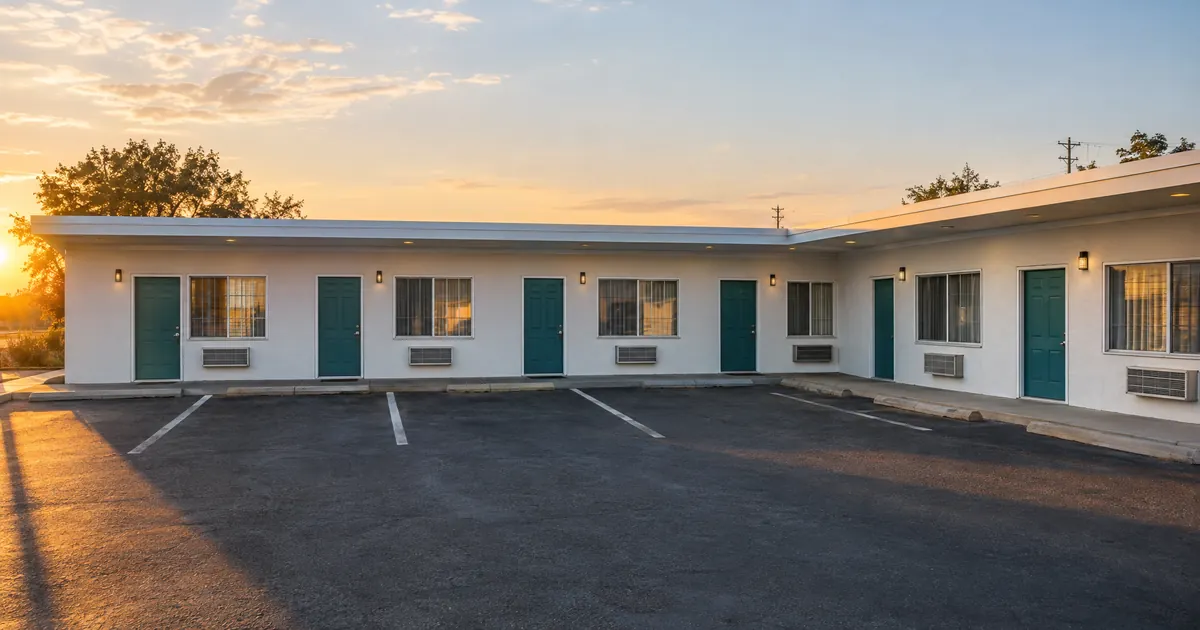
The Quick Read: A lender reviewing a six-unit converted motel decides three things in order: whether six units fits the program at all, whether the building is legally six apartments rather than motel rooms, and whether the appraiser’s rent and value support the loan. Each one can end the file on its own. The coverage ratio comes last.
- Six units sits above the 1-4 unit residential line, so the program set is narrower and the file is reviewed more closely than a fourplex.
- Legal status as residential units, including zoning, permits, and a certificate of occupancy, usually matters more than the rent roll.
- Some programs divide rent by the full monthly payment, while others subtract operating costs first, so the same building can read as two different ratios.
- A DSCR loan is a stabilized-asset product, so an unfinished or unleased conversion usually needs other financing first.
How Does a Lender Classify a Converted Motel?
Classification comes first because it decides which programs even look at the file. Most standard DSCR products are built for one to four units. At five or more units, a building is generally treated as multifamily, and only a smaller set of select lenders in the wholesale network will review it. Availability varies by lender, so a six-unit file is matched to a program rather than dropped into a standard product.
DSCR Calculator
Run the numbers in your market
Rate source: Freddie Mac 30-yr average via FRED® — Federal Reserve Bank of St. Louis · effective Oct 15, 2026
Prefilled with starting assumptions — enter your own rent or nightly figures, taxes, insurance, and HOA for a more accurate picture.
Program parameters update from Lendmire’s centralized guideline source. Taxes and insurance are editable estimates.
As of Oct 15, 2026 · General Freddie Mac market benchmark, not a Lendmire loan offer. Rent, nightly rate, occupancy, taxes, and insurance are editable estimates. Short-term rental figures are estimates only and vary significantly by season, property type, management approach, and local short-term-rental rules — confirm local regulations before relying on them. Qualifying income for short-term rentals varies by program — some use appraisal market rent, others use documented STR history or projections — and is confirmed in underwriting. Not a Loan Estimate, approval, or commitment to lend. Program availability and eligibility are subject to lender guidelines, credit approval, property review, and underwriting.
Then the lender asks what the building is today, not what it used to be. A motel still renting rooms nightly is a hospitality business. DSCR Investor Loans is for rental buildings, and nightly lodging revenue does not look like residential rent. A motel that has been converted, permitted, and leased to residential tenants is a rental building.
| Flag in the file | What the lender checks | Likely consequence |
|---|---|---|
| Still operating as lodging | Current use and licensing | Wrong asset class for DSCR |
| Converted, permitted, leased | Certificate of occupancy, leases | Reviewable as multifamily |
| Converted, no permits | Permit history, unit legality | Highest risk of declining |
| Mixed lodging and residential | Share of each use | Depends on the program |
DSCR loans are designed for non-owner-occupied investment properties. Because they are business-purpose investor loans, they are reviewed differently from a standard owner-occupied mortgage.
What Legal-Use Paperwork Does the File Need?
The file needs proof that each of the six units is a legal dwelling. A converted motel can fail here before any math happens. A kitchenette in a motel room does not make it an apartment. Zoning, building code, and the certificate of occupancy decide that.
On zoning, NAR’s case studies on repurposing vacant hotels and motels note that buyers typically convert the zoning to residential, and they treat whether a zoning application was needed as a key survey point. The report is several years old, so treat it as a description of the general path rather than current local rules.
Building code adds a second layer. Motels are typically classified as transient residential (Group R-1), while apartments fall under Group R-2, and the 2024 International Building Code occupancy chapter lists the residential groups. The International Code Council’s Q&A on the existing building code says a non-sprinklered R-1 building moving to R-2 requires a sprinkler system where the change occurs. Adoption and amendments vary by jurisdiction, so the local building official has the final word.
| Item | Why the lender wants it | Red flag if missing |
|---|---|---|
| Certificate of occupancy | Proves residential use | Units may be unpermitted |
| Zoning confirmation | Shows residential use is allowed | Use may be conditional |
| Permits for conversion work | Shows work was inspected | Unpermitted kitchens or baths |
| Sprinkler or life-safety sign-off | Shows code compliance | Open retrofit cost |
| Rent roll and signed leases | Documents income | Weekly or informal tenancies |
Which Formula Counts the Income?
Programs use one of two formulas, and the program decides which applies, not the building. Many programs divide gross monthly rent by the full monthly payment, meaning principal, interest, taxes, insurance, and any HOA dues. Others use commercial-style math: net operating income divided by annual debt service. In that method, taxes, insurance, maintenance, and other operating costs come out of income first.
| Factor | Rent over PITIA | NOI over debt service |
|---|---|---|
| Income used | Gross rent | Rent minus operating costs |
| Expenses | Not deducted | Deducted before the ratio |
| Typical home | Smaller residential programs | Commercial-style multifamily |
| Effect at six units | Ratio reads higher | Ratio reads lower |
Ask which formula the program uses before choosing a lender. The answer changes the ratio and the loan size the building supports.
One boundary applies to both. DSCR compares rent to the payment and nothing else. Clearing 1.00 is not the same as positive cash flow, because repairs, vacancy, management, utilities, and capital work sit outside the calculation. A former motel often carries heavy ones.
What Does a Six-Unit Example Look Like?
Run it with modeled inputs, not market data. Assume the six units together cover the building’s full monthly payment about 1.25 times on rent over PITIA. That is a hypothetical ratio chosen for illustration.
Now take one unit vacant. Rent falls by one-sixth, and coverage drops to about 1.04x. Take two units vacant, and it falls to roughly 0.83x. Six units is a thin base, because each tenant matters. A converted motel often has shorter or looser tenancies, so turnover can hit the ratio hard.
If the ratio lands below 1.00, the lender usually looks at other structures. Many select programs start at 1.00 coverage. A separate path through select lenders in the network takes coverage below 1.00 with leverage and terms adjusted. Interest-only periods may also be an option through select lenders. Qualification stays subject to lender guidelines, credit review, and the property review. The illustrative calculator on the site lets an investor test a ratio of their own, though it shows an estimate, not a quote.
Under the NOI method, the same 1.25x building can read noticeably lower, because operating costs come out before the test. A former motel may carry costs an ordinary apartment building does not, so the gap can be wider than usual.
How Do the Appraisal and Expenses Work?
At this size the appraisal usually moves to an income approach. Form 1025 is the standard small residential income report, but it covers two to four units, so six units sits outside it. Six-unit files typically get a commercial-style income appraisal that estimates market rent and value from the income stream.
Three points matter most to investors:
- Market rent can override the rent roll. If the appraiser’s rent opinion is lower than leases, many programs use the lower figure.
- Comparable sales are scarce. Few buyers have converted motels, so value support is a risk in both directions, and an appraisal can come in light or heavy.
- Expenses need normalizing. Legacy motel costs such as on-site staff, shared laundry, and owner-paid utilities may be reviewed or adjusted, especially under the NOI method.
Insurance and title are part of this review as well. The policy should reflect residential apartment use, not lodging. The lender will also want to see a unit mix, an operating history if one exists, and entity documents.
Where Does the General Rule Break?
Several situations pull a six-unit conversion away from a standard file:
- Conditional zoning. Residential use in a hotel or tourism zone is often conditional rather than as-of-right. Legal commentary on converting hotels describes that pattern.
- Lost grandfathering. A motel allowed under an older use may lose that status when it is converted or sits vacant. The legal unit count is then questioned.
- Code retrofits. NYS Focus reports that hotel rooms must be retrofitted to residential code when they become homes.
- Small rooms. CalMatters describes planners debating minimum room-size rules because converted rooms run smaller than studios. The example is in California, but the issue can arise anywhere.
- Mixed uses. A lobby, office, or retail space is typically excluded from residential rent. Some units may be nightly or weekly, and a manager’s unit may be unrented.
- Furnished, utilities-included rents. An appraiser compares against unfurnished market rent, so income that includes furniture and utilities may be counted at a lower figure.
What Do Leverage, Credit, and Reserves Look Like?
Program ranges for borrowers are clear, though a six-unit file often lands at the conservative end. Across the wholesale network, a purchase of an investment property typically lands at 75%-80% LTV. A cash-out refinance on a standard rental generally tops out around 75% LTV, with about six months of seasoning as the common expectation. Credit floors start at 620 in parts of the network, most programs want around 660, and 700 or higher opens the strongest leverage tiers. Standard loan amounts run up to $3,000,000.
Reserves vary by lender, leverage, loan size, and transaction type. About six months of PITIA is common, and loans above $1,500,000 typically step up to about nine months. A larger down payment can lift the coverage ratio, but it does not erase leverage caps, credit floors, reserve rules, or property eligibility. The strongest files clear both tests: enough equity and enough rental coverage. All of this is subject to lender guidelines, and every file is underwritten individually. The complete DSCR loans guide covers the baseline requirements.
When Is DSCR the Wrong Tool?
DSCR is the wrong tool while the building is still being converted. A project with open permits, unfinished units, or heavy vacancy has no stable income to measure. Investors typically fund the purchase and work with bridge or construction money, then refinance once the building is legal, leased, and stabilized. NAR’s report notes that bank and other private financing figure in these deals, and it lists federal programs such as LIHTC and HOME for below-market conversions.
Lease-up timing matters in that handoff. Lendmire’s piece How a DSCR Lender Underwrites Infill Houses Still Leasing Up covers the same stabilization question on smaller properties.
After the building is seasoned, some investors pull equity through a cash-out refinance and reuse it on the next purchase. Tax treatment can depend on how the funds are used and how the property is held; investors should keep clear records and speak with a qualified tax professional before relying on any deduction.
A strong traditional employment income cannot offset a weak building here. The file qualifies primarily on property-level rental income covering the payment, subject to lender guidelines, so the building has to carry itself.
Some borrowers hold six units alongside single-family rentals. Lendmire’s piece How a DSCR Lender Counts a Six-Unit Building Plus Houses covers that portfolio question.
DSCR vs. conventional financing
There are two common ways to finance an investment property, and they qualify you differently — here’s how investors weigh them.
Why investors choose it
- Qualifies on the property’s rental income — no personal tax returns, W-2s, or pay stubs needed to document income.
- No personal debt-to-income ceiling to clear, so existing mortgages and obligations don’t cap your borrowing the same way.
- Can be closed in an LLC, keeping the property inside a business entity.
- Built for scaling — not held to the limit on number of financed properties that conventional financing applies.
- Underwriting centers on the deal: generally qualifies when the rent covers the payment, a 1.00x coverage ratio being a common baseline (confirmed in underwriting).
- Designed specifically for investment property, including long-term and, where the program allows, short-term rentals.
Where it’s strong
- Often the lowest ongoing financing cost for a buyer who fully qualifies on personal income — a fit for a first property or a cost-first purchase.
Trade-offs for investors
- Requires full personal income documentation and must fit within a debt-to-income limit — salary, existing debts, and other mortgages all count.
- Typically held in your personal name rather than a business entity.
- Caps how many financed properties you can carry, which can become a ceiling as a portfolio grows.
- Evaluates you as a borrower as much as the property, which usually means more paperwork.
How investors usually choose: a first or single property often optimizes for the lowest financing cost; portfolio builders often optimize for leverage, vesting in an LLC, and scaling past conventional caps. The right answer depends on your goals, the property, and current guidelines — both paths run through select lenders in Lendmire’s wholesale network, with eligibility and terms confirmed in underwriting.
Key Terms Defined
Change of occupancy: A change in how a building is used under the building code, such as a motel becoming apartments.
Certificate of occupancy: The local document that confirms a building may legally be used for a stated purpose.
Group R-1 and Group R-2: Building-code classes for transient lodging such as motels and for apartment buildings.
Rent over PITIA: Monthly rent divided by principal, interest, taxes, insurance, and any HOA dues.
Net operating income (NOI): Rental income minus operating costs, before any debt payment.
Stabilized property: A building that is fully permitted, repaired, and leased, with steady income.
Frequently Asked Questions
Can a six-unit converted motel get a DSCR loan?
It can, when the building is a legal, leased residential rental and a program reaches six units. The network’s programs for five or more units are narrower than for one to four units, and availability depends on the lender. A motel still operating as nightly lodging is not a fit.
Does the lender use my rent roll or the appraiser’s rent?
Often the lower of the two. Many programs rely on the appraiser’s market-rent opinion, and some compare it with in-place leases. Furnished or utilities-included rents may be adjusted down toward unfurnished market rent.
What if the appraisal comes in below the purchase price?
Value drives the loan amount, so a lower appraisal reduces what the lender will provide against the same LTV ceiling. Comparable sales are scarce for converted motels, so the outcome can go either way. A larger down payment can close the gap, but it does not change eligibility rules.
Can a six-unit file work below 1.00 coverage?
Coverage below 1.00 is available through select lenders in the network, with leverage and terms adjusted. Many programs start at 1.00. Eligibility review depends on credit, reserves, the property, and lender guidelines.
Does a strong DSCR mean the property cash flows?
No. DSCR compares rent to the payment only. Repairs, vacancy, management, utilities, and capital work are outside the ratio, and a former motel can carry high amounts of each.
Next Step
If you are buying or refinancing a rental property and want to see how the numbers work, Lendmire, a mortgage broker arranging DSCR investor loans through select lenders in its wholesale network across 41 markets, including Washington, D.C., can help you compare DSCR loan options based on the property income, credit profile, leverage, and investor goals. Reach the team at 828-256-2183. Program details change. This is not a commitment to lend.
About Lendmire
Lendmire (NMLS# 2371349), a non-QM mortgage broker serving investors in 41 markets including Washington, D.C., helps structure DSCR scenarios commonly evaluated around a property’s rental income rather than personal income paperwork, subject to lender guidelines. A Scotsman Guide Top Mortgage Workplace in 2025 and 2026, Lendmire places loans through wholesale investor lenders and is not a direct lender.
Get Started
Ready to find the right loan for you?
In about 30 seconds you can review financing options available for your investment property. No commitment required.
Informational only. Not a Loan Estimate, approval, or commitment to lend. Program availability and eligibility are subject to lender guidelines, credit approval, property review, and underwriting.
References
1. NAR – Case Studies on Repurposing Vacant Hotels and Motels into Multifamily Housing
2. International Code Council – 2024 IBC Chapter 3, Occupancy Classification and Use
3. International Code Council – IEBC Q&A on R-1 to R-2 Change of Occupancy
4. Legal commentary on converting hotels
5. NYS Focus – Zoning Laws and Hotel Conversions
6. CalMatters – Converting a Motel, Step by Step
This article is part of Lendmire’s DSCR loan program — full qualification details, guidelines, and scenarios live on the program page.
Related reading: How a Portfolio DSCR Lender Sets Reserves With a Property Manager · How to Vet a Hard Money Lender Remotely When Exiting to a DSCR Pool · How to Document a Lease to a Relative so a DSCR Lender Counts It
Brandon Miller
Founder & CEO, Mortgage Loan Originator, Lendmire LLC
- Mortgage Loan Originator · NMLS# 1129696 · Verify on NMLS Consumer Access
- North Carolina Real Estate Broker · License# 343312 · Verify on NCREC
- North Carolina Insurance Producer · License# 19053198 · Property, Casualty, Life, Health · Verify on NAIC SBS
- Lendmire LLC · Firm NMLS# 2371349 · Verify firm licensure
Disclosures. The information presented in this article is general market commentary, not financial, legal, or tax advice. Lendmire is a mortgage brokerage (NMLS# 2371349) — not a direct lender or depository institution — and loan placement is subject to lender underwriting. Nothing in this content represents a commitment to lend. Loan terms, pricing, and program availability vary based on borrower qualifications, property characteristics, and state of subject property, and are subject to change at any time. Lendmire complies with Equal Housing Opportunity requirements. Consumer access: nmlsconsumeraccess.org.