
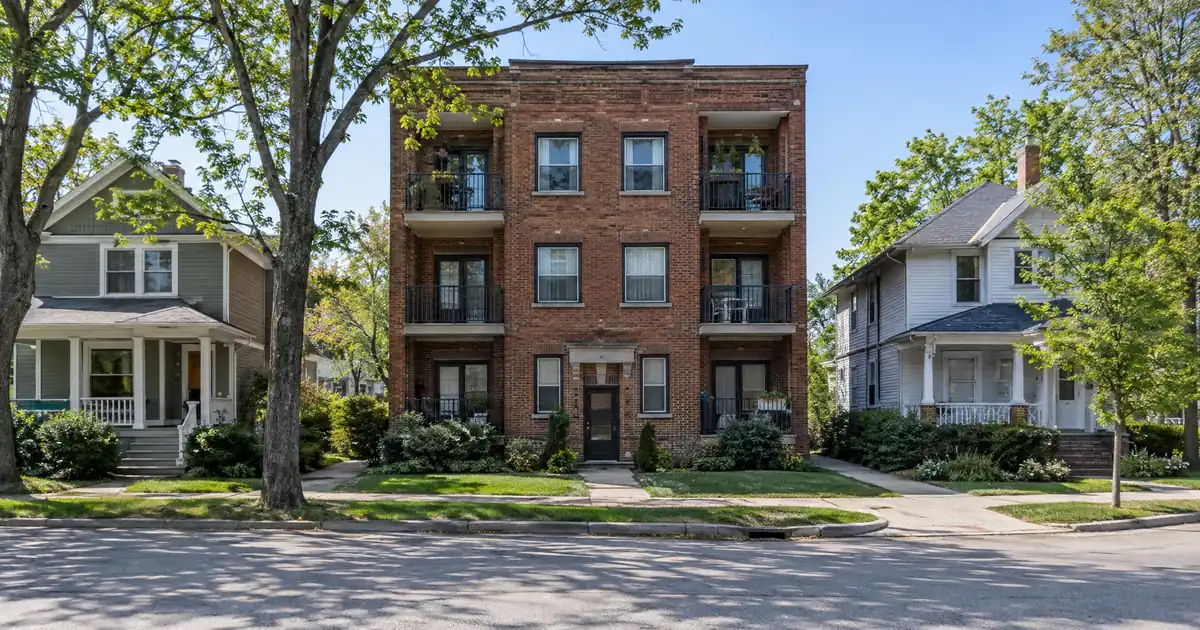
The Quick Read: A lender adds up every unit’s rent to test the six-unit building against its own debt, then tests each house against its own payment, unless everything sits under one pooled loan, where pooled rent is measured against pooled debt service. The sixth unit matters more than the arithmetic does. It moves the building out of house-style underwriting and into small-multifamily review.
- Five units is where the file stops looking like a house loan. A six-unit gets a rent roll, leases, and an operating-income review.
- Each house is tested alone on its own rent against its own payment, so a strong building cannot rescue a weak house on separate loans.
- Under one pooled loan, coverage is measured on the whole pool. Lender programs differ on whether a six-unit can join: the 30-year portfolio loan covers houses and buildings up to four units, while the rental portfolio term loan accepts small multifamily, subject to lender guidelines.
- Clearing 1.00 coverage is not the same as positive cash flow, because repairs, vacancy, management, and capital costs sit outside the test.
Key Terms Defined
DSCR (debt service coverage ratio) is income divided by the debt payment. Wikipedia’s entry on the debt service coverage ratio frames it as net operating income over debt service, where above 1.0 means income covers the debt.
PITIA is principal, interest, taxes, insurance, and association dues. Many programs for houses and small buildings test gross rent against this number.
Net operating income (NOI) is rent minus the costs of running the building, before debt payments. Larger buildings are usually tested this way.
Rent roll is a unit-by-unit list of who pays what, with lease dates. It is the core document for a six-unit.
Blanket loan is one note with a lien on every property in the pool. A batch of loans closed together has separate notes and is not a blanket.
Portfolio loan is a loose term. It usually means a lender keeps the loan instead of selling it. It does not by itself mean the properties are cross-collateralized.
Cross-collateralization means every property backs the whole debt, so one property’s problem becomes the pool’s problem.
Why Does a Sixth Unit Change the File?
A sixth unit changes the file because five units is the line between residential and commercial-style underwriting. The building is reviewed like small multifamily. The houses stay on the residential side.
Most investors expect a six-unit to behave like a big fourplex. It does not. Four units and under can be tested on rent against PITIA, with the appraiser supplying a market rent schedule. At five units, many programs shift to net operating income. They also ask for a rent roll, sample leases, and operating statements.
The pool of lenders shrinks too. Across the wholesale network Lendmire places files with, some lenders offer 5+ unit DSCR programs and others stop at four units. Stabilized, leased buildings fit best.
That is why one six-unit in a deal changes the file for everything attached to it. Before you compare structures, decide whether the building will be financed alone or alongside the houses.
How Does a Lender Count the Six-Unit Alone?
A lender counts the six-unit in two steps. It first builds the building’s income from the rent roll, then tests that income against the building’s own debt. Unit rents are summed first. Everything else comes after.
Here is how the steps run:
1. The reviewer adds in-place rent from the leases on occupied units.
2. Vacant units are handled by program. Some count market rent at a discount, some count only occupied units, and some ask for a lease-up history. Confirm the treatment before you count on a vacant unit.
3. On programs that use NOI, the lender subtracts operating costs such as vacancy, management, and repairs.
4. The result is compared with debt service for the building.
Which formula applies is program-specific.
The five-unit line comes from the agency world. The Freddie Mac Multifamily Seller/Servicer Guide defines multifamily as structures with five or more residential units. DSCR loans are not agency products, so this is contrast only. Still, the definition explains why a six-unit lands on the commercial side while the houses do not.
Mixed-use is a separate matter. A six-unit with ground-floor retail is mixed-use, and mixed-use and commercial property are not offered in the pooled programs described below.
How Does a Lender Count Each House?
A lender counts each house on its own rent against its own PITIA. The test never blends in the building’s income. The result is one coverage ratio per house.
Each house needs a lease or an appraiser-supported market rent. A house leased at a strong figure and a house with no lease in place both get measured against what the appraiser says the home should rent for. Taxes, insurance, and any association dues go into the payment side.
On separate loans, a weak house cannot hide inside a strong building. Each file has to qualify alone. For single-property loans, the credit floor sits at 620 in parts of the network, most programs want around 660, and 700 or higher opens the strongest leverage tiers. Typical purchase leverage runs 75% to 80% LTV on an investment property. Reserves commonly run about 6 months of PITIA, and about 9 months on loans above $1,500,000. All of this is subject to lender guidelines.
A house below 1.00 coverage is not automatically dead. A path below 1.00 is available through select lenders in the network, with leverage and terms adjusted. It is a different path from the 1.00 programs, not a lower floor on the same program.
Some house types are not offered at all. Manufactured homes, log homes, and barndominiums fall outside these programs.
If one of your houses is a short-term rental, Lendmire’s piece What Counts As Short Term Rental Income For A Lender? covers the income side. Short-term rental rules can vary by city, county, HOA, and property type, so confirm local rules before relying on projected rental income.
Three Ways to Structure the Mix
You can finance a six-unit and houses as separate loans, as one pooled loan, or as a hybrid with the building on its own track. The right pick depends on whether the six-unit fits the pool and how much cross-collateral risk you will accept.
| Structure | How coverage is tested | Fits a six-unit? | Main risk |
|---|---|---|---|
| Separate loans | Each property alone | Yes, where a lender offers 5+ units | Each file must stand alone |
| 30-year portfolio loan | The whole pool | No: houses, 2-4 units, condos, townhomes | Cross-collateral exposure |
| Rental portfolio term loan | The whole portfolio | Yes: small multifamily is eligible | Balloon at maturity |
| Hybrid | Building alone, houses pooled | Yes | Two loans to manage |
Here is how each one works in practice.
Separate loans. Each asset gets its own note and its own lien. Each exits on its own, with no cross-default.
The 30-year portfolio loan. This is one note over 2 to 20 properties, with loan sizes from $300,000 to $5,000,000 (larger balances on review). It allows leverage up to 80% of value on a purchase or a refinance without cash out. It carries a 30-year term with a 30-year schedule, an interest-only period is available, and fixed or adjustable structures are offered. Coverage of 1.00 is measured on the pool, so stronger properties can offset weaker ones. Property types are houses, 2-4 unit buildings, condos, and townhomes. A six-unit does not fit. Each figure is subject to lender guidelines and a complete review of property type, leverage, and credit.
The rental portfolio term loan. This one is built for five or more rental properties or units under one loan. Loan sizes run from $500,000 to $50,000,000, with leverage up to 75% of value. Terms are fixed at 3, 5, 7, or 10 years, with a balloon at maturity. Prepayment uses yield maintenance. Recourse and non-recourse versions exist, and non-recourse structures look to the real estate, with carve-outs such as fraud and bankruptcy. Reserves are held for taxes, insurance, and capital expenditures. Small multifamily is an eligible property type, so a six-unit plus houses can sit together here, subject to lender guidelines.
The hybrid. The six-unit goes on its own loan, and two or more houses go into the 30-year portfolio loan. You trade one payment for two, and you keep the building’s risk away from the houses.
Pooled credit floors start at 640, and some structures ask for 680 or 720. A special-purpose entity, typically an LLC, is required on some structures, depending on program guidelines. Owner-occupied property, mobile homes, co-ops, mixed-use, and commercial property are not eligible in the pool.
Worked Example: One Building, Two Houses
Run the numbers on a modeled file. The inputs are assumptions, not market data. The six-unit carries half of the pool’s total debt service. Each of two houses carries a quarter. All six units rent at about the same level.
| Asset | Share of pool debt | Own coverage |
|---|---|---|
| Six-unit building | 50% | 1.30x |
| House A | 25% | 1.10x |
| House B | 25% | 0.90x |
Separate loans. The building clears 1.00 and House A clears it. House B sits below 1.00 on its own. On a separate loan, House B has to go through the select-lender path below 1.00, with leverage and terms adjusted, or its numbers have to improve.
Pooled. Pooled coverage is the debt-weighted average: 0.50 × 1.30 plus 0.25 × 1.10 plus 0.25 × 0.90. That equals about 1.15x. The pool clears 1.00 even though House B does not. A property below 1.00 coverage inside a pool is a pooled-coverage fact, not a separate program. Underwriting tests the pooled coverage, the leverage, and the terms, subject to underwriting.
One unit goes vacant. Say one of the six units sits empty and the lender counts no income for it. The building’s income drops by one-sixth, so its coverage falls from 1.30x to roughly 1.08x. Pooled coverage becomes about 1.04x. A single vacancy took roughly a tenth off the pool’s cushion.
Why the example is optimistic. On an NOI program, the building’s 1.30x would already be after vacancy and operating costs, so the real number may be lower than a gross-rent view suggests. That is why expense assumptions matter more at five-plus units.
What Is the Two-Layer Test?
The two-layer test checks the pool as a whole and then checks each property. The combined test shows whether the portfolio carries its debt. The property check catches one asset hiding behind the others.
The pool-level test is the headline number. Pooled rent against pooled debt service must clear the program’s coverage floor. Lenders can also look at the weakest property. A house with no lease, or with rent the appraiser does not support, can drag a file even if the pooled ratio looks healthy. Every property in the pool needs a lease or an appraiser-supported market rent.
The weak asset has three outcomes. The lender can leave it in, ask you to bring cash down, or ask you to pull it out. If a house is below 1.00 coverage and the leverage cap binds, pulling it out usually improves the pool more than shrinking the loan. That is a judgment call for the file, and it is the main reason to look at each asset alone before you pool anything.
What Goes Wrong With a Pool?
Cross-collateralization is the main risk, because one note over everything means one default can touch every property. Releases and vacancy are the other two. Pooling is not an easier approval, and it has its own costs.
Cross-default. A missed payment on one property can put the whole pool at risk. If you are worried about that, a hybrid or smaller pools limit the exposure.
Release terms. The release price when you sell one property runs above that property’s allocated balance, and the remaining portfolio must still cover its debt service. Read the release clause before you sign. It decides whether you can sell one house without paying off the pool. Lendmire’s explainer Is a Portfolio Cash-Out Refinance Worth Tying Rentals Together? walks through this.
Cash-out on a pool. Cash-out never exceeds 75% of pooled value. Inside the first six months of ownership, the amount is capped by the seasoning rule.
Vacancy sensitivity. The worked example showed it: one empty unit moves the pool. A building has more moving parts than a house, so the stress test belongs in your own spreadsheet before you apply.
Here is the practitioner read from files like this. The lender is rarely the problem on the six-unit. The usual friction is the operating statement. Expenses that look light, or income the building cannot document, change the NOI more than any rent figure does.
What Documents Does the Lender Want?
The paperwork follows the asset type, with the six-unit needing the most.
Six-unit building:
- A current rent roll, unit by unit.
- Sample or full leases.
- Operating statements for the trailing period.
- A small-multifamily appraisal.
Each house:
- A lease, or a market rent schedule from the appraiser (form 1007 covers a single-family house).
- Tax, insurance, and association-dues figures.
- For a 2-4 unit property, the appraiser typically uses form 1025, an income statement for small rental properties.
For a pool:
- An allocation schedule that assigns debt to each asset.
- The release terms written into the note.
- Entity documents, where a special-purpose entity is required.
- A guarantor standing behind the pool on recourse structures.
How Do You Decide?
Choose on three questions: does the building fit the pool, how much cross-collateral risk can you carry, and do you want one payment or several. Start with the building because it has the fewest options.
If the six-unit stands strong alone, separate loans or the hybrid keep it independent. If you want one note over everything, the rental portfolio term loan is the pooled path that accepts small multifamily. Check the balloon at maturity and the yield-maintenance prepayment before you commit. If your houses are the stronger group, a pool of houses plus a stand-alone building keeps the best assets together and the six-unit’s operating risk apart.
Remember what clearing the test means. DSCR compares rent to PITIA only, so a ratio above 1.00 is not positive cash flow. Repairs, vacancy, management, utilities, and capital costs sit outside the calculation. A larger down payment can lift the ratio, but it never erases leverage caps, credit floors, reserve rules, or property eligibility. For the full framework, see Lendmire’s complete DSCR loans guide.
Tax treatment can depend on how the funds are used and how the property is held; investors should keep clear records and speak with a qualified tax professional before relying on any deduction.
Frequently Asked Questions
Does all the rent count?
On an NOI program, operating costs come out before the test. On a rent-over-PITIA program for houses, gross rent is compared with the full payment.
Can a house’s extra rent help the six-unit?
Only inside a pool. On separate loans, each property is tested alone, so extra rent from one house does nothing for another. In a pool, coverage is measured on pooled rent against pooled debt service, so stronger properties can offset weaker ones, subject to underwriting.
Does the six-unit need its own loan?
Not always. The 30-year portfolio loan does not take a six-unit. The rental portfolio term loan accepts small multifamily, so a six-unit can sit with houses there, subject to lender guidelines. Many investors choose a stand-alone loan for the building to keep it separate.
What if one unit is vacant?
Expect the vacant unit’s income to be discounted or left out, depending on the program. The result lowers the building’s coverage, and in a pool it lowers pooled coverage by a smaller amount. A lease-up history can help the file.
Can I sell one property later?
On separate loans, yes. In a pool, partial releases and substitutions follow the loan documents. The release price runs above the property’s allocated balance, and the remaining portfolio must still cover its debt service.
Next Step
If you are buying or refinancing a rental property and want to see how the numbers work, Lendmire can help you compare DSCR loan options based on the property income, credit profile, leverage, and investor goals. Lendmire is a broker that arranges financing through select lenders in its wholesale network across 41 markets, including Washington, D.C. Whether a six-unit rides in the pool or stands on its own is the first question to settle, because it changes every other number in the file.
About Lendmire
A DSCR-focused mortgage broker, Lendmire (NMLS# 2371349) places investor financing across 41 markets — 40 states plus Washington, D.C. — with DSCR eligibility generally reviewed by the lender on property cash flow instead of tax returns, subject to lender guidelines. Scotsman Guide named Lendmire a Top Mortgage Workplace in 2025 and 2026.
Get Started
Ready to find the right loan for you?
In about 30 seconds you can review financing options available for your investment property. No commitment required.
Informational only. Not a Loan Estimate, approval, or commitment to lend. Program availability and eligibility are subject to lender guidelines, credit approval, property review, and underwriting.
References
1. Wikipedia, Debt service coverage ratio
2. Freddie Mac Multifamily Seller/Servicer Guide
This article is part of Lendmire’s DSCR loan program — full qualification details, guidelines, and scenarios live on the program page.
Related reading: Can One DSCR Lender Finance All Four LLC-Held Tower Units? · Does a DSCR Lender Accept Airdna Projections for a New-Build STR? · How to Mix Houses, Duplexes and Condos in One DSCR Loan
Brandon Miller
Founder & CEO, Mortgage Loan Originator, Lendmire LLC
- Mortgage Loan Originator · NMLS# 1129696 · Verify on NMLS Consumer Access
- North Carolina Real Estate Broker · License# 343312 · Verify on NCREC
- North Carolina Insurance Producer · License# 19053198 · Property, Casualty, Life, Health · Verify on NAIC SBS
- Lendmire LLC · Firm NMLS# 2371349 · Verify firm licensure
Disclosures. The information presented in this article is general market commentary, not financial, legal, or tax advice. Lendmire is a mortgage brokerage (NMLS# 2371349) — not a direct lender or depository institution — and loan placement is subject to lender underwriting. Nothing in this content represents a commitment to lend. Loan terms, pricing, and program availability vary based on borrower qualifications, property characteristics, and state of subject property, and are subject to change at any time. Lendmire complies with Equal Housing Opportunity requirements. Consumer access: nmlsconsumeraccess.org.