
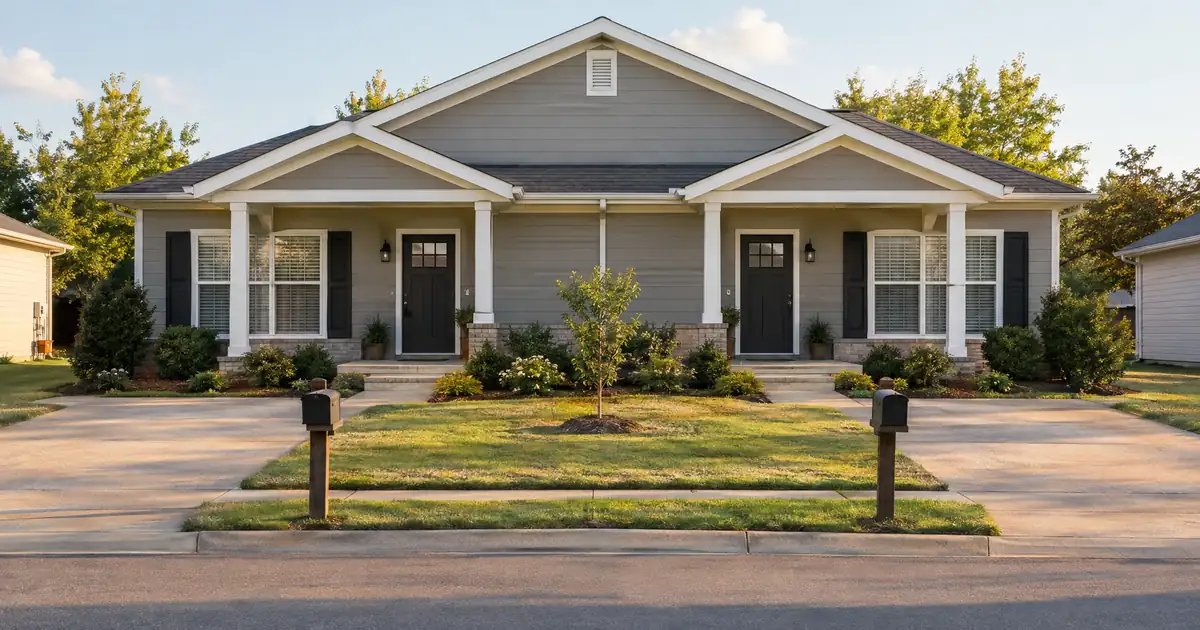
The Quick Read: Usually yes, because a home equity line is sized on the property’s equity, and a vacant unit mainly weakens the income side of the file; still, lenders often discount or exclude that empty unit’s rent, and some want a tenant in place first. A HELOC is a home equity line of credit. How the lender classifies your duplex matters more than the vacancy itself.
- Live in one unit and the line is typically reviewed as a primary residence. Rent both units and it is reviewed as an investment property.
- On an investment property, the network ceiling is 70% combined loan-to-value, with a 700 credit minimum and a $500,000 maximum line.
- A vacant unit does not shrink the equity ceiling. It can shrink the rent a lender will count toward your debt-to-income ratio.
- If the HELOC route stalls, a DSCR cash-out refinance reviews the property’s rent instead of your personal income, and it can use market rent for the empty unit.
Key Terms Defined
HELOC: a revolving line of credit secured by the property, usually in first or second lien position, with a draw period followed by repayment.
CLTV (combined loan-to-value): all loans on the property added together, divided by its value.
Occupancy class: how the lender labels the property: primary residence, second home, or investment property. It sets leverage and credit limits before anything else.
DTI (debt-to-income): your monthly debts divided by your monthly income. A HELOC leans on this ratio.
DSCR (debt service coverage ratio): monthly rent divided by the full monthly property payment. That payment is principal, interest, taxes, insurance, and any association dues (PITIA).
Rent roll: a simple schedule listing each unit, its tenant, and its rent.
Vesting: how title is held. It might be an individual, a revocable trust, or an LLC.
How large a line the equity supports.
An equity line is sized by combined loan-to-value, occupancy, and credit — not by rental coverage. Switch the occupancy or the credit band and the ceiling moves with it.
Investment-property lines require a 700 minimum credit score; second-home lines start at a 640 minimum and primary-residence lines at 600, and the combined-LTV ceiling steps down as the credit band drops on primary-residence and second-home lines and holds on investment-property lines; the line cap steps down on primary-residence lines and holds at every tier on investment-property and second-home lines.
A debt-to-income ratio above 45% requires 680+ credit. Profiles under 640 are limited to single-family homes. At least 75% of the approved line is drawn at closing. Ceilings, floors, and caps update from Lendmire’s centralized guideline source.
Line estimate
Illustrative estimate only — not a quote, Loan Estimate, approval, or commitment to lend. The rate is an editable assumption; equity-line pricing is variable through both the draw and repayment periods and never converts to fixed. Occupancy and credit drive the ceiling together: an investment property tops out at 70% combined LTV (minimum credit 700, line cap $500,000); a second home tops out at 90% combined LTV (minimum credit 640, line cap $500,000), with the ceiling stepping down as the credit band drops (the cap holds at every tier); a primary residence tops out at 90% combined LTV (minimum credit 600), and its $750,000 maximum line is available only at 75% combined LTV or below with a 700-or-better credit profile (720 on the longer-runway program) and a full appraisal. Lines above $500,000 require a full appraisal. Credit, debt-to-income, property type, and full underwriting review all affect the final line.
Why a Vacant Unit Hits Income, Not Equity
The size of the line comes from value, the CLTV ceiling, the balance on your first mortgage, and the line cap. Rent is not in that formula. Picture two duplexes with the same value and the same mortgage balance. One is fully leased and the other is half empty. Both produce the same equity ceiling.
Whether you reach that ceiling is a different question. Your credit, your income, and your DTI decide that. This is where the empty unit bites. A vacant unit has no lease and no deposits, so the lender has nothing to count. Many lenders also discount the rent they do count, and the size of that haircut varies by lender.
Some lenders will decline the file until a tenant moves in. Others will work with it. Across Lendmire’s wholesale network, a unit that is vacant between tenants is a judgment call on the file’s facts, and nothing in the lease paperwork is a decline reason by itself. Still, the honest advice is to ask before you apply, because each hard credit pull and appraisal cost is money spent on a maybe.
One more reality check. Rental lines are a narrow product. NerdWallet reports that fewer lenders offer a HELOC on an investment property, requirements are stricter, and you can borrow less than against a primary home, because lenders see higher default risk on rentals. Big banks often skip the product entirely. So “every bank does this” is a myth.
Occupancy Comes First
The question of whether you live in the building outranks the question of whether a unit is empty. Occupancy sets the leverage ceiling, the credit minimum, and the valuation path before rent enters the picture.
| Your situation | Typical review class | What it means |
|---|---|---|
| You live in one unit | Primary residence | Higher ceilings, income-based file |
| You rent both units | Investment property | 70% CLTV ceiling, 700 minimum |
| Empty unit is the one you’d live in | Depends on your intent | Classify by how you will occupy it |
| Both units empty after purchase | Investment, usually | Little or no rent to count |
Here is the trap for owner-occupants. On a primary residence, the network ceiling reaches 90% CLTV, but only at a 720-or-better credit profile. That is not the figure for a duplex you rent out. On an investment property, the ceiling is 70% CLTV, with no tier above it. Always match the ceiling to the occupancy you will actually have.
Misstating occupancy to reach a higher tier is a bad idea. Lenders verify it, and it puts the whole file at risk. If you plan to move out in a few months, tell the lender.
What the Vacancy Changes and What It Doesn’t
| Side of the file | Does a vacant unit change it? |
|---|---|
| Value and equity ceiling | No |
| CLTV cap and line cap | No |
| Credit score tier | No |
| Rent counted toward DTI | Yes, often zero or discounted |
| Lender comfort | Yes, varies by lender |
Not all vacancies read the same way. A broker sees three kinds, and lenders may treat each differently.
Vacant between tenants. The unit is rent-ready and marketed. This is the easiest to explain. A listing, a prior lease, or a market-rent estimate gives the lender something to look at.
Vacant for renovation. The unit may not be habitable yet. Some lenders want each unit separately functional before they will lend. Finish the work first.
Vacant long term. No marketing, no lease history, no plan. This is the hardest to explain and the most likely to draw a decline.
If you live in the other unit, rent from the empty one is not automatic income. Never assume full credit for it. When the second unit is leased, lenders often add some of that rent to your income at a discount, or net it against the property’s own payment.
The Network Numbers on a Rental Duplex Line
These are typical guidelines from select lenders in Lendmire’s wholesale network, subject to lender guidelines and full file review. They are not a commitment to lend.
- Leverage: 70% CLTV on an investment property. Credit above 700 buys eligibility, not extra leverage, because 700 and 720 reach the same ceiling.
- Credit: 700 is the floor for an investment line, with no tier beneath it.
- Line size: an investment line tops out at $500,000. There is no investment tier above that.
- DTI: 50% maximum. The lender tests it on the interest-only payment at the full draw, not on what you plan to borrow.
- Structure: a 5-year interest-only draw followed by a 25-year repayment. At least 75% of the line is drawn at closing. Pricing floats and never converts to fixed.
- Valuation: a line at or below $500,000 ordinarily uses an automated valuation, so a traditional appraisal is commonly not part of an investment HELOC.
- Property: single-family, 2-4 units, townhomes, and condos can qualify. Mixed-use buildings do not. A duplex with a small commercial suite falls outside the product.
- Exposure: a borrower is limited to three lines in total, and owning more than 15 financed properties is disqualifying.
- Availability: Lendmire’s HELOC placements cover a narrower set of states than its DSCR footprint of 41 markets, including Washington, D.C.
Two to four units count as residential collateral. Five or more units is commercial lending. Within two to four units, the unit count does not change the CLTV table.
Title is the sharpest catch. The borrower must hold title as an individual or in a revocable living trust. An LLC cannot hold title on this line. That is lender policy, not a federal ban. If your duplex already sits in an LLC, you need a vesting change or a different product.
A Same-Duplex Walkthrough
Run the numbers on one duplex through two scenarios. Assume the same value and the same first mortgage balance in both.
Scenario one: both units leased. The equity ceiling comes from 70% CLTV on an investment property, minus the existing mortgage, subject to the $500,000 cap. Leases and a matching deposit trail document the rent. The lender counts some of that rent in your DTI.
Scenario two: one unit vacant. The equity ceiling is identical. The lender counts rent from the occupied unit and little or nothing for the empty one. Your DTI rises. If your wages and other income carry the file anyway, the vacancy may not matter. If you leaned on rent to clear the ratio, it can be the difference between approval and a decline.
(This is why two investors with the same building get different answers.)
The stronger play is usually to decide which test your file is built to pass. A salaried borrower with low debts can often ignore the vacancy. A borrower who needs the rent to qualify should lease up before applying. A signed market-rate lease in hand can lift the rent used for review, subject to program rules.
Bank-statement income can substitute for traditional personal-income documentation on some files. That path, and what a vacant unit does to it, is covered in Lendmire’s piece Can You Get a Bank Statement HELOC With One Unit Vacant?.
Documents to Gather
For the occupied unit:
- A lease and a deposit trail that match.
- Your mortgage statement and proof of insurance.
- A rent roll listing both units.
For the vacant unit:
- A current listing or marketing record.
- A prior lease, if one exists.
- A market-rent estimate.
- A short letter explaining why the unit is empty and the plan to re-let it.
- For a renovation vacancy, proof the work is near completion.
If the empty unit is rented short term, platform history documents the income. Short-term rental rules can vary by city, county, HOA, and property type, so investors should confirm local rules before relying on projected rental income.
Apply Now, Lease Up First, or Switch Products?
Think of it as a three-way fork.
Apply now if your credit and DTI clear without the empty unit’s rent. The vacancy is then mostly a footnote, and the equity ceiling is unaffected.
Lease up first if you need the rent to qualify, or the lender you are talking to declines vacant units. This costs time but usually improves the file. Be careful with a lease that is about to end. A lender may count a vacated unit’s rent at zero, so the lease works as occupancy evidence rather than a guarantee of income.
Switch products if the building is a pure rental and your personal income is the weak link. That leads to the next section.
If the Answer Is No: Plan B
A decline on the HELOC does not end the equity conversation. Compare the alternatives side by side.
| Option | Reviewed on | Vacant unit treatment |
|---|---|---|
| Investment HELOC | Your credit, DTI, equity | Rent often discounted or excluded |
| DSCR cash-out refinance | Property rent vs. PITIA | Appraiser’s market rent used |
| HELOC on another property | That property’s file | Not affected by this duplex |
| Cash-out on a primary home | Your income and equity | Not affected by this duplex |
A DSCR loan is a business-purpose loan that qualifies primarily on property-level rental income covering the payment, subject to lender guidelines. For a duplex with a vacant unit, that structure can fit better. The appraiser completes a rent schedule for each unit (Form 1025 covers two to four units). The rent used is the lower of the lease and the appraiser’s market rent, and a vacant unit uses market rent, often with a letter of explanation.
Typical ranges from select lenders in Lendmire’s network for a DSCR cash-out refinance:
- Leverage: up to about 75% LTV on a cash-out of a standard long-term rental, with about 6 months of seasoning commonly expected. Short-term rental collateral caps lower, at around 70% on a cash-out.
- Coverage: 1.00 is where many select programs start. A separate select-lender path goes below 1.00, with leverage and terms adjusted.
- Credit: a 620 floor exists in parts of the network, most programs want around 660, and 700 or better unlocks the strongest leverage.
- Loan size: up to $3,000,000 on standard programs (smaller balances available through select lenders), with 30-year fixed structures the norm and extended terms or interest-only periods available through select lenders.
- Reserves: commonly around 6 months of PITIA, though they vary by lender, leverage, and loan size.
- Title: an LLC can hold title, subject to lender program eligibility.
Now the caveat. DSCR does not fit a duplex you live in. If you occupy a unit, it is a different product, and DSCR works once the property is a pure rental. Also, clearing 1.00 is not positive cash flow. Repairs, vacancy, management, utilities, and capital expenses all sit outside the calculation.
Picture a modeled duplex where the lease on one side and market rent on the other produce coverage near 1.1x. That clears the floor for many select programs. It says nothing about what the owner actually keeps each month. For the full picture of how these loans work, see Lendmire’s complete DSCR loans guide.
The Risk Nobody Puts in the Brochure
The payment on the line does not care whether the unit is occupied. Because the line is qualified on the interest-only payment at the full draw, and at least 75% is drawn at closing on the investment structure, a floating-price line with a vacant unit puts real pressure on cash flow. Stress-test your budget with the empty unit earning nothing for a full stretch. If that number breaks you, the line is too big.
Overleveraging is the quieter danger. Equity you can borrow against is not equity you should. Leave room for a bad vacancy and a surprise repair.
One more point: the extra cooling-off period you may expect with a home loan often does not apply here. The federal three-day right to cancel attaches to a principal dwelling under Regulation Z. A law firm explainer notes it does not reach a rental, vacation home, or investment property. On a duplex where you live in one unit, the answer depends on whether that unit is your principal dwelling, so get counsel before assuming either way.
Tax treatment can depend on how the funds are used and how the property is held; investors should keep clear records and speak with a qualified tax professional before relying on any deduction.
One Practitioner Note
On duplex files, the vacancy itself rarely sinks the loan. What sinks it is a vacancy plus a thin DTI plus an unexplained story. The borrowers who do best bring the explanation, the listing, and the plan to the first conversation. That turns an empty unit from a red flag into a timing detail.
For owner-occupants weighing the same question, Lendmire’s article Can You Get a Rental HELOC on a Duplex If You Live in One Unit? covers that classification in more depth.
Frequently Asked Questions
Can I get a HELOC on a duplex if one side is empty?
Often, yes. The equity ceiling does not change, so the vacancy matters mainly through your DTI and the lender’s comfort. Some lenders decline until a tenant is in place, so ask before you apply.
Will a lender count rent from the vacant unit?
Usually not, or only at a discount. There is no lease and no deposit history, so the lender has little to verify. Market-rent evidence and a listing can help on some files, but never assume full credit.
Does a vacant second unit change my occupancy class?
Not by itself. Occupancy follows how you will use the property. If you live in one unit, the line is typically reviewed as a primary residence. If you rent both, it is an investment property with a 70% CLTV ceiling.
Can my LLC take out a HELOC on the duplex?
Not on this product. An individual or a revocable living trust must hold title. If the duplex is already in an LLC, you would need a vesting change, or a DSCR cash-out refinance instead.
Is a DSCR loan easier with a vacant unit?
It can fit better, because it is reviewed on the property’s rent covering the payment, and the appraiser’s market rent can stand in for the empty unit. It does not suit a duplex you live in, and coverage below 1.00 is available only through select lenders, with leverage and terms adjusted.
Next Step
If you are considering a home equity line and want to see how the numbers work, Lendmire can help you compare HELOC options based on the property, the equity available, credit profile, combined leverage, and your goals. As a broker, Lendmire places these files with select lenders, and each lender decides on eligibility.
Whether you fill that vacant unit before applying or after, the equity in the building stays the same, and the income story is the part you control.
About Lendmire
Lendmire is a mortgage brokerage (NMLS# 2371349) arranging home equity lines of credit — primary-residence, second-home and investment-property lines — through a wholesale lending network in its 16 full-service states. Eligibility is determined by the lender on each file. Scotsman Guide named Lendmire a Top Mortgage Workplace in both 2025 and 2026.
Get Started
Ready to find the right loan for you?
In about 30 seconds you can review financing options available for your home or investment property. No commitment required.
Informational only. Not a Loan Estimate, approval, or commitment to lend. Program availability and eligibility are subject to lender guidelines, credit approval, property review, and underwriting.
References
1. NerdWallet – HELOC on an investment property
2. CFPB – Regulation Z § 1026.23
3. Beacon Law Partners – Home Equity Loans and HELOCs: Draw Periods, Freezes, and Rescission Rights
This article is part of Lendmire’s home equity line of credit program — full qualification details, guidelines, and scenarios live on the program page.
Related reading: HELOC Tiers for a First-Time Equity Borrower on a Primary Home · How a HELOC Funds Four Years of Tuition for a Parent Borrower · How Much Home a First-Lien HELOC Down Payment Supports After DTI
Brandon Miller
Founder & CEO, Mortgage Loan Originator, Lendmire LLC
- Mortgage Loan Originator · NMLS# 1129696 · Verify on NMLS Consumer Access
- North Carolina Real Estate Broker · License# 343312 · Verify on NCREC
- North Carolina Insurance Producer · License# 19053198 · Property, Casualty, Life, Health · Verify on NAIC SBS
- Lendmire LLC · Firm NMLS# 2371349 · Verify firm licensure
Disclosure information. Lendmire is a state-licensed mortgage brokerage under NMLS# 2371349. Lendmire is not a depository institution, direct lender, or financial advisor — all loans referenced are placed through wholesale lender partners and are subject to each lender's underwriting standards. This article is provided for general informational purposes and is not a commitment to lend, nor does it constitute financial, legal, or tax advice. Loan programs, terms, rates, and qualification standards change without notice and depend on borrower profile, property type, and the state in which the subject property is located. Equal Housing Opportunity provider. NMLS Consumer Access: nmlsconsumeraccess.org.